



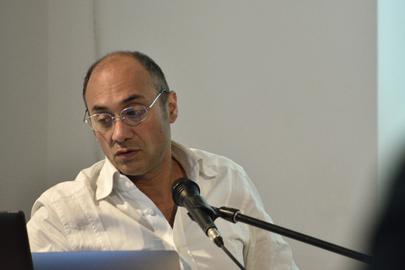
Robert Weinberg is a writer on art and a radio and podcast producer, whose features and exhibition reviews have appeared in numerous publications, including The Telegraph, Apollo, The British Art Journal, and IranWire. In this interview, he speaks with curator Dr. Vali Mahlouji about his groundbreaking project to preserve and exhibit Kaveh Golestan’s photographs of Tehran’s red-light district, the Citadel of Shahr-e No.
In early 1979, two days before the return of Ayatollah Khomeini to Iran, a devastating fire consumed the walled-off neighborhood of Tehran known as the Citadel of Shahr-e No. This area was the city’s red-light district, accessible only through a single gate. Many of the women within perished in the blaze. Those who managed to escape were arrested, and several were executed by firing squad that same year, becoming the first women sentenced by the new Islamic courts. The remnants of the Citadel were erased in an act of cultural cleansing. For decades, the Citadel had existed on the margins of a rapidly transforming society. Its eradication served as a harbinger of the oppressive years to come, according to visionary London-based curator Vali Mahlouji, who has been researching its history. Since 2014, Mahlouji has been displaying the Citadel's story in museums around Europe and Asia, reconstructing its history around Kaveh Golestan’s photographs of its inhabitants made in the mid-1970s.
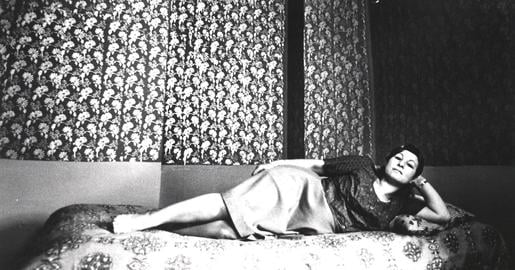
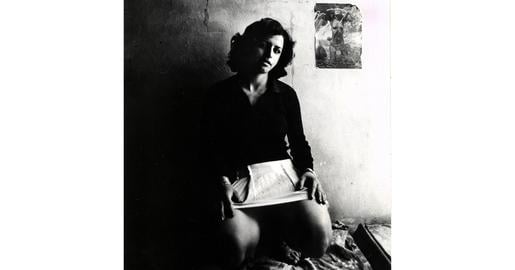
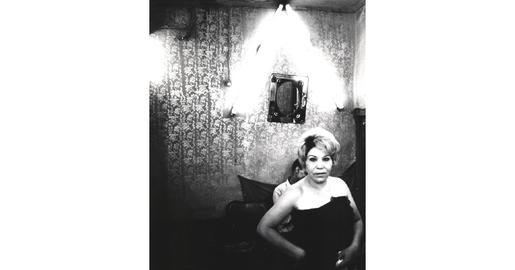
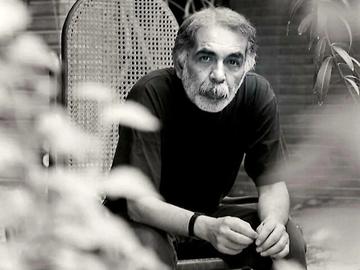
A few years before the Citadel's destruction, Golestan, a documentary photographer, was granted unique access to photograph the women of Shahr-e No. Born in 1950, Golestan came from an intellectual family and was partly educated in England. He was working as a correspondent for the BBC when he was killed by a landmine in Iraq in 2003. However, with the 200 photographic negatives he made of the Citadel's inhabitants, Golestan ensured that this vanished world would not be forgotten. Taking these pictures took Golestan several years, requiring long visits to the Citadel to gain the trust of its residents. The images were made between 1975 and 1977, and Golestan himself hand-printed 61 of the negatives. The photographs remained unseen until Mahlouji recirculated them in 2014.
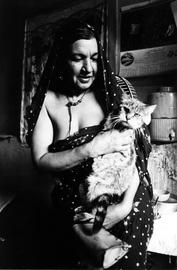
“Golestan showed his photographs in 1978 at the University of Tehran, but the exhibition was shut down very shortly after it opened because it was seen as provocative,” Mahlouji explains. “The area had become a walled inner-city ghetto since the coup in 1953. Its residents and activities were hidden from sight, and Golestan wanted to break that invisibility.” But, in Mahlouji’s view, Golestan’s striking images go beyond merely depicting their subjects.
“I think this group of photographs constitutes the strongest study of the female figure in late 20th-century Iranian photography,” Mahlouji says. “Golestan was deeply socially engaged and politically driven, with a distinctive eye. He was opinionated about issues and claimed he was documenting, as he said, the truth. Of course, the truth is a difficult concept, especially in photography. But Golestan was very much of the post-Vietnam school, where photography gave agency to the dispossessed.”
Golestan was part of an active intellectual milieu in 1960s and 1970s Iran, driven by social conscience and striving to expose and incorporate the marginalized into the mainstream. “There was a prevalent Iranian intellectual trajectory at the time, focusing on the natural rights of citizens who were not part of the metropolitan dynamics,” says Mahlouji. “At its core, it was a push to expand the moral circle and altruism to include all those who were otherwise treated as lesser citizens. For me, it coincides with the expansion of law, legal rights, citizenship rights, and natural rights.”
Documenting the Citadel was an act of social conscience for Golestan, a way to resist the forces that sought to erase the margins of society. “That’s exactly why people like him pursued these projects. They went against prejudices and ambivalences from both below and above,” says Mahlouji. Golestan originally conceived the women’s images as one third of a triptych, depicting a tragic cycle of urban migration, poverty, and dispossession: the laborer arrives in Tehran, meets the sex worker, and together they bring into the world a child destined to be forgotten by society. “He kept notes about his imagined triptych,” says Mahlouji. “They are somewhat romanticized in an artistic sense. A large group of the images are premeditated, composed, and choreographed. In some ways, they’re highly aestheticized. You may read them as objectifying the women, or you may see them as giving them agency and space to express themselves - to exist rather than be pitied. Artistically, the series stands as a superb set of portraits of people. There isn’t a sense of ‘us and them.’ I believe Golestan successfully sublimates the layers of unequal power dynamics.”
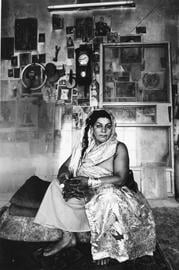
For the past decade, Mahlouji’s touring exhibition, titled Recreating the Citadel, has embedded Golestan’s photographs within their broader social context, as the photographer would have wanted. “I go back to the 1920s and excavate the history of the creation of the red-light district,” says Mahlouji. “I then push the history through Golestan’s portraits to the district’s destruction. Today the area is submerged under a park, artificial lake, and theater for various recreational pursuits. These are significant to my study as they represent a form of re-territorializing an urban space and erasing a contentious history, ensuring that no traces remain. There are also no traces of the scars inflicted on the people who lived there, for which nobody was ever held to account. No justice was ever administered. There was no investigation into how the fire started, who initiated it, or who carried it out. It was seen as a natural wrath of society, instrumentalized as people’s anger toward the decadence of the monarchy in Iran.”
Mahlouji has observed that viewers are profoundly affected by the photographs. “The audience inevitably experiences some kind of shared horror,” he says. “Overcoming grief has a social dimension. It does not happen individually, especially when it is of a social nature. So when people pass through the exhibition, they witness people already in a compromised situation. The first time we showed the exhibition in Amsterdam, people literally came out pale-faced.”
Since 2010, Mahlouji - through his Archaeology of the Final Decade (AOTFD) project - has been devoted to excavating and recirculating artists, artworks, and cultural accounts that have been obscured, censored, or destroyed. He sees it as a kind of socio-political archaeology, aiming to restore these narratives to social memory. Resurrecting Golestan’s archive - comprising some 250,000 mostly unseen negatives—is a major endeavor, offering a new generation the opportunity to engage with a past that is still relevant today.
“There’s everything from visual documentation of early rural schools to meetings of the Writers Association to political rallies to workers at various factories,” Mahlouji says. “It’s a very broad visual archive of the social and political history of Iran. As a whole, I believe it comprises the most important visual document of late 20th-century Iran.”
Mahlouji is now trying to raise funds to digitize, index, and archive all of Golestan’s materials to make them accessible to historians, researchers, and anyone interested in Iran’s social and political history. The forthcoming publication of Golestan’s photographs of the Citadel of Shahr-e No will be a critical step in this journey. It will be the first time that the 61 portraits will be published. With the book’s content complete and production underway, Mahlouji is now fundraising to cover the costs of material, graphic design, editing, and distribution through Hatje Cantz Verlag in Berlin. In addition to the photographs, the book will include pioneering research into themes of gender apartheid, state violence, and civic resistance, making it an essential contribution to a broader discourse on gender, sexuality, and state-imposed violence under the Islamic regime. “They are very provocative,” says Mahlouji, “and I am being subversive, and of course, it is a very sore point with the Islamic Republic, especially the way I contextualize it.”
In a world where cultural erasure is all too common, AOTFD is using the power of art to transcend boundaries, revive forgotten histories, and offer hope. Among the diverse cultural legacies they are reclaiming, Mahlouji - who also trained as a psychoanalyst - sees Golestan’s photographs as a starting point to recreate the history of the Citadel. “These kinds of scars live within our bodies, our social psyche, and our historical imagination without us being aware of them. I use this Freudian analogy of repressed historical memories. The whole project is about allowing repressed memories to resurface, to explode them into the present. When you’re looking at the pictures now in a book, they’re a document of a time gone by and a vanished aspect of the city and culture.”
Once a site of secrecy and shame, the Citadel of Shahr-e No and its lost inhabitants can now - thanks to the efforts of Vali Mahlouji - be reclaimed as symbols of resistance and resilience.
To contribute to the publication that will bring together Kaveh Golestan's Prostitute Series for the first time, visit: https://www.indiegogo.com/projects/citadel-and-the-photography-of-kaveh-golestan#/

Interested in writing for IranWire?
Share your stories.



comments