



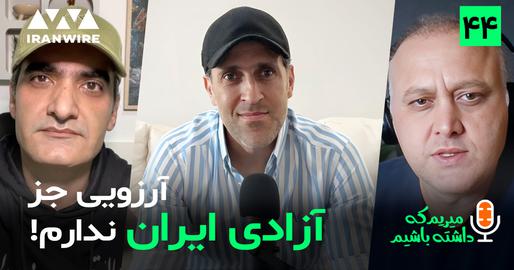
Ali Karimi, a legendary Iranian football star, was the guest on IranWire’s sports podcast this week. Ehsan Pirbornash, the host of the podcast, and Payam Younesipour, IranWire’s journalist, spoke with Ali Karimi about his life after leaving Iran.
During the 2022 uprising, the retired football player used his notoriety to defend the protesters who faced a bloody crackdown by security forces.
Karimi is known among his fans as the magician of Iranian football.

During his career, Karimi captained Iran’s national team, as well as Persepolis and Steel Azin football clubs. He has scored 127 goals and was Asian Footballer of the Year in 2004.
Here are excerpts from the video interview, which is fully available on IranWire’s YouTube channel.
I Follow the Iranian League, Less So Europe
Pirbornash: These days, I receive many messages from inside and outside Iran, telling me to “look out for Ali.” You’ve always supported a group of people or players. How can people look out for you?
Karimi: The people of Iran have always been nice to me. If it weren’t for their good wishes, I might not be here today. I have no words.
Pirbornash: Few people have been as popular among Esteghlal FC fans as you. For instance, the late Nasser Hejazi and Mansour Pourhedari from Esteghlal were always respected and loved by Persepolis fans. Do you feel the energy people give you in your life?
Karimi: If it weren’t for that energy, I don’t know how I’d be doing now. My only way of connecting with people is through social media. The messages from people in Iran have given me the energy to keep going. When I say “the people of Iran,” I mean those who, whether inside or outside the country, love Iran and want to see it reach its true potential. I hope I can one day repay this kindness from the Iranian people.
Younesipour: Ali Karimi’s identity in the minds of Iranians was formed by football, just like how they first got to know Abbas Kiarostami through cinema and later embraced his words. After everything that has happened, do you still watch football? Do you follow domestic or international matches?
Karimi: Since I launched my YouTube channel, yes, I watch games as much as I can. But if I look back at the last two years, I have to say no. For two years, I really didn’t follow football news or events. You might not believe it, but I didn’t even watch the 2022 World Cup. Now, circumstances have changed, and I need to be able to talk about football events, so I need to increase my knowledge. My main focus now is on the Iranian football league. I’m watching more games and following the controversies and incidents. As for European football, I’m not as precise, and I mostly just follow the highlights.
Younesipour: Do you enjoy watching the games or the results, or are you just following to increase your knowledge?
Karimi: A few days ago, during the 104th derby (Esteghlal vs. Persepolis), I expected the game to end in a draw, but then those things happened in the last minutes, and Persepolis won. The unpredictability of football still excites me. I enjoy watching emerging stars and new talents more than the results these days. At this point, I think it’s more important for my favorite teams to play well than to win.
Pirbornash: You two [Ali Karimi and Payam Younesipour] share a mutual feeling about Mehdi Taj [the president of Iran’s football federation]. I just don’t know which of you hates him more.
Younesipour: I don’t have hatred, but it’s more about the knowledge I gained about him during the years I worked at Jahan-e-Football newspaper.
Karimi: Sorry to interrupt, but when you worked at Jahan-e-Football, weren’t your salaries delayed every month, and instead of your salary, they gave you nougat?
Younesipour: Yes, but unlike the famous nougat, there were no coins hidden inside.
Karimi: Well, those coin-filled nougats were meant for other people elsewhere.
Pirbornash: Mehdi Taj was the owner of Jahan-e-Football. What happened that led you to form such an opinion of him?
Younesipour: Out of respect for all my colleagues at Jahan-e-Football, I won’t go into too many details, but the image that was formed for me was that of a manager embodying all defined forms of corruption. Here’s a simple example: One year, the Ministry of Culture decided to either give newspapers subsidies or provide paper. Without informing the newspaper’s managing director, Mehdi Taj went and took hundreds of millions of tomans in cash, and didn’t tell anyone. For more than six months, we were scrambling to find paper, and the newspaper’s managers were negotiating with the Ministry for the annual paper quota. Eventually, everyone found out that Mr. Taj had even swindled his own newspaper. Now imagine what someone like him could do in a place like the Football Federation.
Karimi: My personal belief is that Mehdi Taj only established Jahan-e-Football to make a comeback in football. At the time, it was one of the top three or four sports outlets in Iran. With the help of that newspaper, after being pushed out of Sepahan FC, he managed to get back into football. He was removed from the corruption circle at Foolad Mobarakeh, but through the influence and connections he had, and by presenting himself as part of the military, he elevated himself again in football. Mehdi Taj used to present himself as a companion of Martyr Hemmat.
This man had a cousin who had been in the war, and he took advantage of his connections to establish a newspaper, where all his employees were unhappy. With that newspaper, he re-entered the football scene.
Karimi: I remember the first time I saw Mehdi Taj at the national team camp during Safaei Farahani’s tenure. He had a rosary in his hand, standing in a corner, head bowed, and whenever he saw one of us, he would say: “Hello sir, I’m at your service, I’m your servant,” while counting his rosary beads. This man, as just a spectator, wormed his way into the national team camp and eventually took over the youth teams. In a normal system, this person should be behind bars. Mehdi Taj’s only purpose is to carry out the government’s orders in football, and he has no other role in Iranian football.
Seyed Ali Should First Think About His Own Safety, Then About Ours
Younesipour: Do you remember the day the news of Mahsa Amini’s death came out? Where were you, or how did you feel? Was it more anger or sadness and sorrow?
Karimi: Well, it’s not easy to talk about this. It’s been about two years and a few days, and naturally, I don’t remember the exact moment. But the posts I shared on my social media probably show what I was feeling for my fellow countrywoman. This event broke the hearts of most Iranians, not just mine. Given the problems the government had caused for people in the months leading up to this, Mahsa Amini’s death was like a wake-up call for the people.
Karimi: I was outside of Iran and could speak freely. Many public figures inside Iran also reacted as much as they could. If you remember, a few months before, I had an issue with one of these clerics in Qom. He used vulgar language about football players, and I responded. I think in Mahsa Amini’s case, people felt they had to start somewhere to reclaim their country. Unfortunately, this wake-up call came at the cost of losing a loved one, but I always say that to achieve something great, you must lose something dear. After Mahsa, we lost hundreds of other loved ones: Nika, Sarina, Mohsen Shekari, Majid Reza Rahnavard, and many more. I hope the blood of these dear ones is not in vain, and the Iranian people get to see the change they desire, whether I’m there or not. If I’m not there that day, celebrate on my behalf too.
Younesipour: Let me add that about four months before the nationwide protests began, you had posted about Hassan Abbasi and Ali Akbar Raefipour. Before that, you had a post addressing Javad Zarif as well.
Karimi: I called him “the Cat.” Look at his style. (Laughs)
Younesipour: Yes, when Javad Zarif said in Hassan Rouhani’s government that “our people chose to live this way,” you responded by asking, “Which ‘we’? Our ‘we’ or your ‘we’?”
Karimi: Believe me, I don’t remember much of what I said back then, but some things are coming back to me now. By the way, have you heard anything about Hassan Abbasi and Raefipour? Why are they nowhere to be seen?
Younesipour: If they haven’t been arrested as Israeli spies, maybe their time is up.
Karimi: I’ve heard similar things about Esmail Qaani, but considering what Mossad has done recently, I think it’s clear that if they wanted to choose someone as a spy, the person would need at least 30 per cent or 40 per cent IQ. Now, I’m saying this, and they’ll come back and claim that Ali Karimi has sold his social media to Mossad and Israel.
Younesipour: You also had a clash with Ms. Ebtekar, head of the Department of Environment, over Lake Urmia. Ultimately, in one of his most important speeches in 2018, Ali Khamenei addressed you and Voria Ghafouri, saying, “Remember where your security comes from,” but it didn’t affect you. I often wonder if Ali Karimi had been in Iran after Mahsa Amini’s death, would he still have spoken out like Voria Ghafouri, Ali Daei, Yahya Golmohammadi, Karim Bagheri, and many others? What future would have awaited Ali Karimi then?
Karimi: Regarding the part about our security, I think Seyed Ali should now be more concerned about his own security. When Reuters, with all its credibility, reports that Ali Khamenei has been moved to a “safe house,” it surely means it has happened. He should first worry about himself, and we’ll figure something out for ourselves.
Karimi: As for the other part, naturally, if I were in Iran now, I wouldn’t have the freedom I have today. That’s very clear. Many people in Iran showed their true colors in the first five or six months, stood by their fellow citizens, and paid the price - they were banned from transactions, banned from working in their professions. Surely, if Ali Karimi were in Iran, he would have paid the same price and would have been controlled just like the others. It’s not like I’m sitting outside the country and claiming that if I were in Iran, I’d do the same things. That’s a complete lie.
Karimi: You saw in our football how they pushed certain people out of the game, out of coaching. I understand many people in Iran. For many, it’s hard to digest why they don’t react. I put myself in their shoes and think that maybe, just maybe, if I were in their place, I’d stay silent too. But my main point is, if you can’t stand with the people because of your circumstances in Iran, at least don’t let the regime use you as a tool. I always say, anyone with the ability wouldn’t bow down to this regime.
Pirbornash: When I was in Sari prison, I spoke with some young men and teenagers who had been arrested during the protests. They said they had come out just because Ali Karimi told them to. Have you heard this yourself?
Karimi: Yes. Even now, these cyber agents come to my social media pages and write that I sent the youth to their deaths. What’s interesting is that this regime hasn’t been able to find a single slip-up or scandal in my record from all the years I was in Iran to use against me. So their only solution is to get their cyber agents to insult me on my pages and then later claim on their networks that Ali Karimi led people to their deaths.
Younesipour: I’ve often written two things about you on IranWire. One, whether on the football field or off, no one should anger Ali Karimi because once you reach that point, you can’t be controlled. The other is that there’s no financial or moral scandal about you. What I often think about is how, after standing with the protests and the people, Ali Karimi lost many of his assets. His home, his life, his possessions, and even his dogs. Someone close to you said last year that when you traveled to the UAE, you left just enough food for your dogs for a short time.
Karimi: There’s documented evidence of everything they did to my house. They brought those huge concrete barriers and placed them in front of my house. Half an hour later, they sent me photos of my house and half an hour after that, I went to sleep. When I woke up in the morning, I saw they had removed the barriers at 1 a.m. due to public protests. Afterward, they claimed I had sold the house. Well, show me one document, one buyer, or one piece of evidence.
Karimi: I couldn’t and can’t sell that property at all. The owners of that house are my sons, each owning half. Even if they free up my house now, I can’t touch it. As for the dogs, I had five, all purebred and good breeds. I’m only glad that as soon as the events started, I moved the dogs out of there and sent them to a friend of mine who is in the dog breeding business. A few months ago, a friend messaged me asking if he could have one of the dogs. I told him they were with this guy, but we followed up and found out that due to financial difficulties, he had given away the dogs and disappeared. Just look at the state of the country, people can’t even maintain businesses like dog breeding anymore.
Karimi: One thing I must emphasize regarding my house: If anyone believes the regime’s claims about Ali Karimi’s house being sold are true, let them go and wait outside my house for half an hour. That’s it.
Younesipour: No, Ali. Not even half an hour. Ten minutes would be enough.
Karimi: I say half an hour. Let them stay there and see what happens. We have friends and neighbors there. Some of them send me pictures. They don’t even know how to turn off the smart home system. The last picture I received about a month ago shows my house looking like a haunted house from a horror movie. I believe all Iranians have paid a price in this struggle. I hope all of us who have stood against this regime will see the day when all these sufferings and losses come to fruition.
Pirbornash: I remember you posted a story about the sale of confiscated property by the Islamic Republic. I think you wrote that as the rightful owners of these assets, we don’t give consent for our properties to be sold by the regime or for people to buy them.
Karimi: That was the only thing I could do. After all, some regular people want to invest, and I don’t want them to waste their money. Many people left the country after the revolution, and their properties were confiscated and sold. I just say, if you want to invest, buy a property that won’t cause trouble. One day, even if I’m not around, my kids will return and want their property back. This regime won’t last forever.
Younesipour: It was said that Ali Karimi charges a hefty fee if he wants to interview with any media outlet. Well, right now, as Ehsan Pirbornash and I are talking to you, Maziar Bahari, the owner and founder of IranWire, isn’t even aware of this. But as a joke, Ali, if you did charge us, let the IRGC and cyber agents know ahead of time.
Karimi: How many media outlets have I spoken to in the past two years?
Younesipour: Almost none.
Karimi: I had one interview with Max Amini, and he was a dear friend. Max Amini’s network gave some parts of the interview to Manoto TV. Personally, I haven’t spoken to anyone to even charge a fee.
Pirbornash: That one interview was enough, Ali.
Karimi: Yes, yes, it was enough. Unfortunately, unlike the clerical regime, I didn’t manage to set up wealth for myself and my descendants for generations to come. Hopefully, in future contracts, I’ll manage that.
Younesipour: Ali Karimi, besides your wishes for your family, what’s your biggest wish?
Karimi: Freedom for Iran. That’s it. Really, that’s all.
Younesipour: Really, nothing else comes to mind?
Karimi: No bigger wish. After all, I’m older than you, and death comes to the elderly first, so I hope I live long enough to see a free Iran, a country with all its wealth and such kind-hearted and compassionate people. I hope to see Iran at its peak in the region.

Interested in writing for IranWire?
Share your stories.


comments