



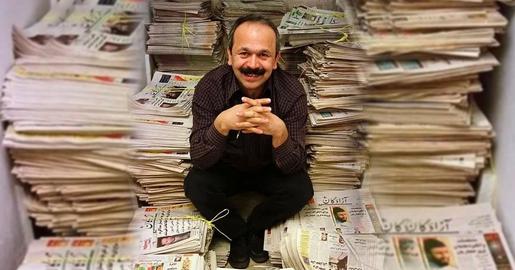
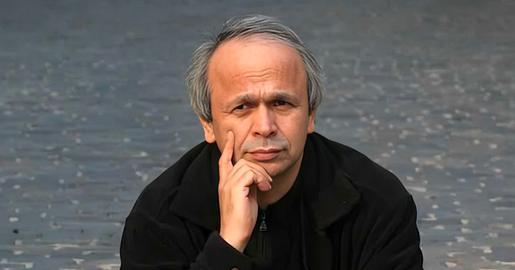
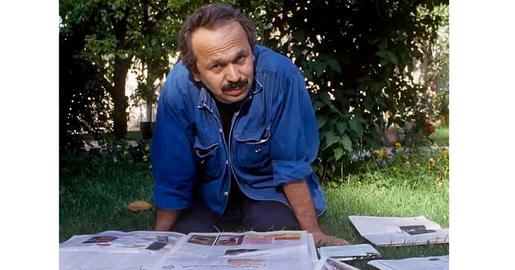
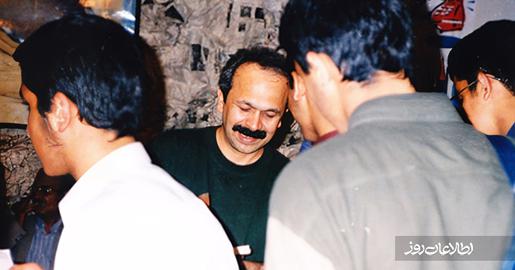
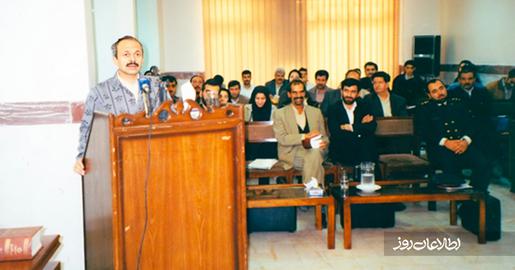
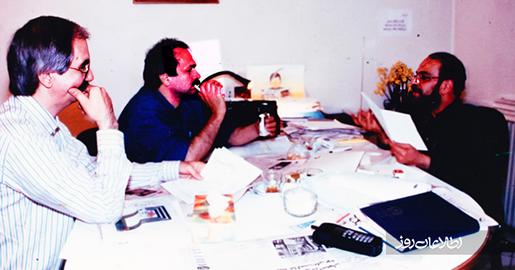
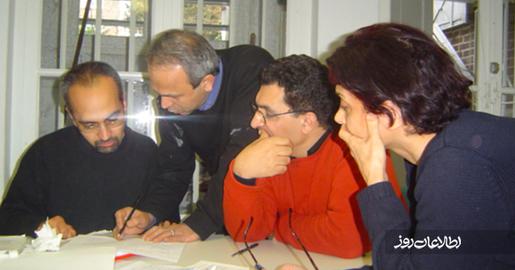
The late 1990s marked Ebrahim Nabavi’s emergence as a literary phenomenon in Iran when hopes for reform swept the country.
His satirical columns not only became bestsellers in book form but also drew crowds rivaling those of entertainment celebrities at press events during the hopeful but fleeting period known as the “Second of Khordad” era.
Nabavi, whose political satire in Iran’s reformist-era press brought both fame and exile, died by suicide on Wednesday at his home in Silver Spring, Maryland. He was 64.
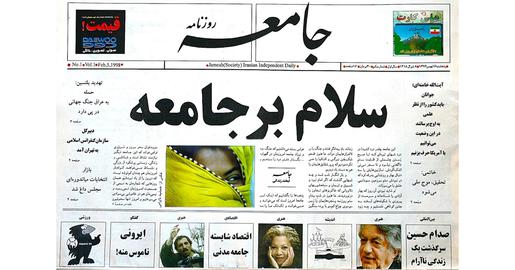
Nabavi’s Fifth Column in the newspaper Jame’eh became a defining voice of Iran’s late 1990s reformist movement.
He dissected the contradictions of Iran’s political establishment with precision and used humor to expose the hypocrisy that straight reporting couldn’t touch.
An example of this is a satirical piece published in the spring of 1998 in Jame’eh newspaper, which was groundbreaking for its time in Iran.
The writer of the Fifth Column - a reference to enemy spies in the military - was the 37-year-old, talented Nabavi.
Before this, he had interviewed Mohsen Makhmalbaf for Soroush magazine, written film reviews for another film magazine - Gozaresh-e-Film - analyzed social issues at the Ministry of Interior during Mohammad Khatami’s presidency, and humorously wrote under a pseudonym in Gol Agha magazine.
Nabavi’s rapid rise as a satirist quickly made him one of the standout stars of Iran’s “Second of Khordad” press, which appeared after Khatami’s election.
His columns turned into bestselling books, and at press festivals, people lined up to meet him. During those brief, hopeful days in Iran - soon to turn dark - he achieved a level of celebrity comparable to famous film and television stars.
Reflecting on those years, Nabavi later wrote that the popularity of his satirical Fifth Column extended far beyond newspaper readers.
The renowned writer Houshang Golshiri, author of Prince Ehtejab, wrote a detailed analysis of the column’s political satire in Jame’eh. Meanwhile, philosopher Babak Ahmadi described it as a reflection of the rising literary quality enabled by a relatively open political climate - a brief and fragile window of reform.
During that time, Nabavi began incorporating interviews with political figures into his work. These were often people who, despite having played key roles in establishing the Islamic Republic, had quickly fallen out of favor with the clerics.
For the first time in years, readers encountered names like Abbas Amir-Entezam, the former spokesperson of the interim government following the fall of the Shah, who had been sentenced to life imprisonment after a sham trial on charges of colluding with the U.S. government.
Similarly, Ebrahim Yazdi, a close ally of Ruhollah Khomeini during the 1979 Islamic Revolution, reemerged after nearly two decades through an extensive interview with Nabavi in Jame’eh.
These interviews went beyond newspapers. Nabavi also conducted an in-depth interview with Ehsan Naraghi in Paris, which was published as Dar Khesht-e Kham (In the Raw Brick). Naraghi, a former advisor to Iran’s Queen Farah Pahlavi, had been largely sidelined in post-revolution Iran.
In the book, Nabavi recounts his earlier encounter with Naraghi in 1978 when he was a sociology student at Shiraz University.
“Back then, we were immersed in figures like Shariati, Marx, and Darwin, and we saw Naraghi as a puppet intellectual - someone who put on a suit, tied his tie, wore cologne, and went off to serve the court and solidify the foundations of tyranny. We even planned to disrupt one of his lectures.”
After Jame’eh was shut down, its successor, Tous, carried Nabavi’s satirical column under a new name: The Fourth Column. It continued until Tous was also banned, and Nabavi was arrested and imprisoned in Evin for a month over his writings.
During his interrogation, Nabavi told his interrogator, “A year from now, I’ll win an award for the very thing I’ve been imprisoned for, and I’ll go on pilgrimage to Mecca. There, I’ll pray for you to be guided to the right path.”
True to his prediction, he went on a pilgrimage and kept his promise to pray for his interrogator.
When the editors and writers of Jame’eh launched the newspaper Neshat, Nabavi’s satirical column became a cornerstone and inspired many publications of the time to create similar sections.
His column evolved under new names - Chel-Sotoun (Forty Columns) in Neshat, and later Bi-Sotoun (Without Columns) in Asr-e-Azadegan newspaper after Neshat was banned.
Nabavi’s satire remained a defining feature of this era’s press, even as the political landscape grew increasingly repressive.
With each of these arrests in the late 1990s, Iran’s political environment became increasingly oppressive. Then, after an angry speech by Ali Khamenei at Tehran’s Mosalla in April 2000, where he called the press “the enemy’s base,” Nabavi, along with many others, was once again imprisoned.
In just a few days, under Khamenei’s orders - who had angrily declared that he could easily “halt the media rebellion” - more than twenty newspapers and magazines were shut down.
A new era of suffocating oppression had begun in Khamenei’s Iran.
This time, Nabavi was charged with “insulting the authorities,” referring to Khamenei, and “insulting the establishment.”
In his trial, presided over by the infamous judge Saeed Mortazavi after a month and a half in solitary confinement and three months in general prison, Nabavi acknowledged, “We were extreme in our approach.”
Kayhan newspaper falsely published this quote with the headline “We were wrong,” and this marked the beginning of a major blow to Nabavi.
By then, he had progressed from being a star journalist for Iran’s reform-minded readers to a political hero, but after this trial, his supporters began seeing his apology as a regretful admission of his actions.
His popularity began to wane.
When Nabavi was released from his second imprisonment, the political and social atmosphere in Iran had changed.
Hopes for reforms promised by Mohammad Khatami faded, and expectations for the Sixth Parliament turned into disappointment, with Khamenei leading the change.
The government at this point had begun publishing newspapers like Jam-e-Jam, which was run by Ali Larijani, a key figure in the anti-reform camp.
Nabavi’s role as a satirist in a newspaper affiliated with Larijani felt like no less of a blow than the aftermath of his court.
He did not remain in Iran much longer. After migrating to Europe, he spent time in Belgium and later moved to the United States, where he lived for the remainder of his life.
During his time in Europe, he continued writing satire for the online newspaper Rooz and also contributed to several Persian-language websites outside of Iran.
His writings in Rooz evoked memories of his earlier days in Jame’eh, but he never regained the same level of success, influence, or popularity.
His continued support for reformist candidates in Iranian elections did little to restore his lost popularity, and it seemed to even hurt his reputation.
Reports later emerged that the Ministry of Culture had refused to renew the publication rights for his books.
These were not just collections of his political satire, but also works on the history of Iranian humor, as well as rewrites and edits of the Persian satirical legacy.
One of these books included selections from Zahr al-Rabi by Seyed Ne’matollah Jazayeri, a Shia cleric who had written politically and socially charged satire.
One of Jazayeri’s quotes read, “It is said that a Major General of an army should have some traits of animals - bravery like a rooster, courage like a lion, fierceness like a wild boar, and cunning like a fox. The moral conclusion: when a man fights, he becomes like an animal.”
In his later years, Nabavi, though far from the fame he had in the 1990s, was still remembered by his former admirers. He kept a relatively low profile, feeling isolated and yearning to return to Iran. The country he had left was no longer the one he had once hoped for.
In the introduction to his book Journey to the Freed Home, he described himself in a way that resonated with him for the rest of his life, and perhaps even intensified during his years in exile:
“Our Muslim identity is a story in itself - first for others, and then for ourselves. Our Muslim identity is neither the kind that allows one to become a minister or gain a press permit, nor the kind that would allow one to consider themselves among the inhabitants of heaven.
“In religious intellectuals’ view, we are both insiders and outsiders - they are careful that our hands do not touch those who pass by, so they are not forced to wash them, and they don’t want to be in a picture with us.
“When we are in the company of intellectuals, we are often pushed to the side, forced to answer questions like: ‘Which football team did you support when you were fifteen? At twenty, under which flag did you mourn [during Ashura]? When did you shorten your beard, and when did your moustache grow long?’”
A brilliant Persian satirist, a treasure of Iran’s comedic history, and a full-fledged writer in an era of sorrow and a bleak future for Iran, Nabavi never ceased longing for his homeland.
After nearly two decades of forced exile, he took his own life at the age of 64, leaving behind a legacy of satire that was interrupted by the very authoritarianism that shaped his life.
His death marked the end of an era of political satire in Iran, an era that was cut short by the oppressive clerical establishment.

Interested in writing for IranWire?
Share your stories.


comments