



In a region where public libraries are scarce and concentrated in city centers, a grassroots organization is quietly transforming access to books in western Saqqez, one neighborhood at a time.
The Hiwa-e-Zanist Association (hope of knowledge) has established 10 libraries over the past decade in underserved neighborhoods and surrounding villages.
Three of these libraries bear the names of significant women, reflecting the organization’s commitment to highlighting female role models in a traditionally conservative region.
The success of their initiative is perhaps best illustrated by the recent expansion of their Nashmilan Library, which is now too small to accommodate its growing community of young readers.
What makes the association’s achievement particularly remarkable is its independence from government funding. Instead, they have woven together a network of community support.
Their only interaction with official institutions occurs during the necessary process of obtaining construction permits.
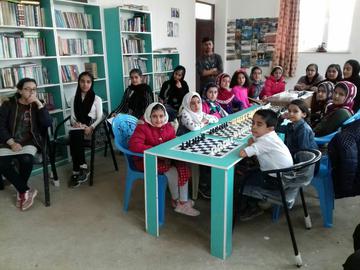
While these libraries might be small in size, their impact extends far beyond their walls. In addition to lending books, they have become cultural hubs where children gather for Kurdish and English language classes, and where local authors launch their works.
Nashmilan Library: Expanding
The library was established in the Nashmilan neighborhood of Saqqez, named after the area itself.
It is located three kilometers away from the city’s main public library, a distance that is both time-consuming and costly for children from marginalized areas. It was opened in 2016 in a 24-square-meter space within a green area in Nashmilan.
The library, with over 11,000 books, has become cramped due to the high demand from children and teenagers.
In recent days, members of the association have added around 12 more square meters to the space to accommodate the growing number of visitors.

Jila Hosseini Library: In Baharestan Neighborhood
Jila Hosseini, a poet and radio host for Radio Sanandaj, was born in 1964 in a village near Saqqez.
Her grandfather, Sheikh Abdolqader Hosseini, was an influential figure in the region, a poet, and a calligrapher. Her father, Sheikh Mehran, was a respected judge and one of the city’s trusted figures.
Jila Hosseini was an admirer of Sherko Bekas, the renowned Kurdish poet. In 1996, at the age of 32, while on her way to Tehran to meet Sherko Bekas, she died in a car accident on the Sanandaj-Dehgolan road, along with her daughter.
Due to the similarities between her life and death and that of the famous Iranian poet Forough Farrokhzad, as well as their shared poetic style, she was sometimes referred to as the “Forough of Kurdistan.”
In 2018, in recognition of Jila Hosseini’s contributions to poetry and literature and her inspiring impact on women in Saqqez, the association established a library in her name in the Baharestan neighborhood.
Despite the association’s efforts to purchase land for the library, they were unable to do so, and the library was set up in a rented basement. The Jila Hosseini Library has become one of the most active libraries.
Mofideh Mazhar Library: In Ghavkh Neighborhood
Mofideh Mazhar is a Saqqez-based writer primarily focused on children’s literature. Her father, Nafe’h Mazhar, was a well-known poet in Kurdistan.
To honor her contributions to literature, the association established a library named after her in the Ghavkh neighborhood.
Ghavkh is one of the most deprived neighborhoods in Saqqez, with no cultural or sports facilities. To address this lack, the association opened the Mofideh Mazhar Library in a rented space, ensuring the community has access to cultural resources.
Maryam Mirzakhani Library: In Kani Asheghan Neighborhood
Maryam Mirzakhani, a renowned mathematician and professor at Stanford University, died shortly after receiving the prestigious Fields Medal in 2017.
In 2021, a library in her name was established by the association in a local park in the Kani Asheghan neighborhood.
The construction of the library was made possible through contributions from a philanthropist, along with support from activists and professionals in the construction sector, and membership fees from the association’s members.
The library aims to facilitate access to books for the children of this marginalized neighborhood.
Caucher Birkar Library: In Markhaz Village
Caucher Birkar, a Kurdish mathematician from Marivan and the second Iranian after Maryam Mirzakhani to win the Fields Medal, is currently teaching at a university in China.
A library named after the mathematician has been established in the village of Markhaz, 15 kilometers from Saqqez.
The association named the library in honor of Birkar to inspire children to pursue education and achieve academic success, just as Birkar, a rural native, has risen to global prominence.
Savareh Ilkhanizadeh Library: In Torjan Village
Savareh Ilkhanizadeh was a poet, writer, political activist, and Kurdish-language broadcaster for Radio Tehran.
Born in 1937 in Torjan, a village near Saqqez, he earned his law degree from Tehran University while also engaging in political activism. Due to his nationalist activities, he was imprisoned for six months in 1964.
In 1967, Ilkhanizadeh became the Kurdish-language broadcaster for Radio Tehran. He died in 1975 in a car accident.
To honor his memory, the association established a library in his birthplace in 2017.
The library, built on a 50-square-meter plot, lends books and hosts educational courses on topics such as Kurdish language, agriculture, water management, and beekeeping.
Mamosta Hejar Library: In Kani Sefid Village
Abdulrahman Sharafkandi, known by his pen name Hejar, was a renowned Kurdish writer and poet born in 1921 in Mahabad. He died in 1990.
The association established a library in his name in Kani Sefid, a village 70 kilometers from Saqqez, in collaboration with the Children’s Book Council. The library began operations with a collection of 2,000 books.
Sharif Bajoor Library: In Bashmagh Village
Sharif Bajoor was a civil rights and environmental activist from Marivan. He lost his life, along with three of his friends, while combating widespread fires in Marivan in 2018.
To honor his memory, the association established a library in his name in Bashmagh, a village 30 kilometers from Saqqez, and donated more than 2,000 books.
Qeshlagh Pol Village School and Library
The two-classroom school was built in 2017 with the help of a philanthropist. Located in Qeshlagh Pol village, 20 kilometers from Saqqez, the land for the school was donated by a local villager.
The school includes a library, one of the few rural schools in Iran to do so, which is open to the public. The library is managed by the association.
Industrial Town Library
Located in Saqqez’s industrial town, 5 kilometers from the city, the library was established in 2018 with 1,450 books to benefit the children of workers in the town.
The library’s activity has been limited due to the smaller number of workers in the industrial units and the absence of their families in the town.
Every Home Deserves a Library
In addition to building libraries in marginalized neighborhoods and remote villages, the association has launched cultural projects.
These include literary gatherings, book launches, introducing books to children, honoring poets and writers, and addressing educational and developmental issues. These programs are held periodically at the established libraries.
The Hegbe Zanist project may be the association’s most important activity after building libraries.
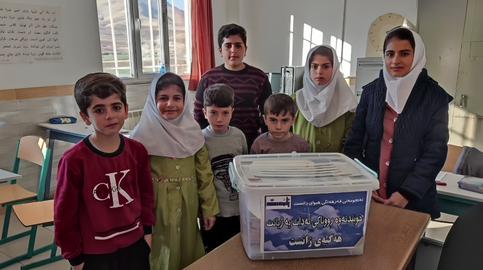
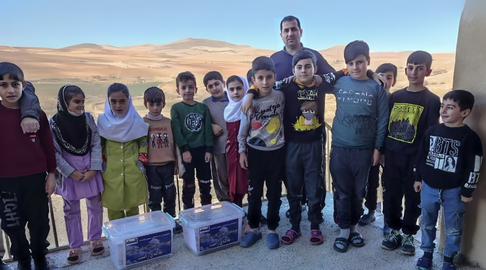
In this project, members pack books and deliver them to villages, giving them to the village council or mayor with the slogan, “Every home deserves a library.” The books are then shared with children under local supervision.
Cultural Activities Under Security Scrutiny
The association struggles with limited funding, relying mostly on philanthropists, and faces legal challenges and scrutiny from security agencies.
During the 2022 Woman, Life, Freedom protests, some members were arrested.
Azad Amini, the head of the association, was arrested on the first anniversary of Mahsa Amini’s death in custody. Saqqez is Amini’s hometown.
Security forces raided his house and searched his home and personal belongings. He was released on bail after a few days.
Shilan Rashidzadeh, the manager of the Jila Hosseini Library, was also arrested during the protests. She was transferred to Sanandaj and released on bail nearly two months later.

Interested in writing for IranWire?
Share your stories.


comments