



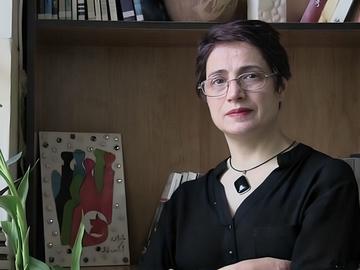

"I oppose mandatory hijab."
These four words, printed on simple badges, have cost Reza Khandan six years of his life.
Since December 13, 2024, the human rights activist has been confined to Ward 8 of Tehran's notorious Evin Prison, separated from his wife, renowned human rights lawyer Nasrin Sotoudeh, and their children.
Khandan’s imprisonment represents more than one man’s struggle. It symbolizes the systematic targeting of human rights defenders in Iran and the heavy price their families pay for their activism.
Now, more than 1,500 prominent international figures are demanding his release through a campaign that has gained global attention.
Khandan, along with physician and fellow activist Farhad Meysami, was first arrested in 2018 for creating and distributing badges opposing mandatory hijab.
Although sentenced to six years in prison, he was later included in a mass pardon during the Mahsa Amini protests that swept across Iran in 2022.
For several years, he lived a relatively everyday life with his wife, who herself has endured multiple imprisonments for defending women’s rights, religious minorities, and political dissidents.
Then, without warning, authorities appeared at their door on December 13, 2024, to enforce the sentence issued in 2018.
The timing was no coincidence, according to Sotoudeh.
“Reza’s arrest was actually a kind of revenge for a law they couldn’t implement,” she explains. “I’m referring to the 'Chastity and Hijab' law, which was approved but never enforced.”
The controversial legislation, which prescribed harsh punishments for those opposing mandatory hijab, was scheduled to be announced by the Speaker of Parliament on December 13.
When the announcement failed to materialize, authorities instead arrested Khandan on the same day.
Since entering Evin Prison, Khandan has endured more than the loss of freedom. He reported unhygienic conditions and a severe bedbug infestation, eventually staging a hunger strike to demand improvements.
“They used direct flames to eliminate the bedbugs,” Sotoudeh says. “But after four months, they returned to Ward 8.”
She added that others who publicly spoke about the infestation were themselves sentenced to prison.
Beyond physical hardship, Khandan faces emotional and psychological torment from being separated from his family.
Sotoudeh has been permitted to visit her husband only once since his arrest. Their daughter traveled from the Netherlands to see her father but was denied visitation.
Perhaps most disturbing was the treatment of their teenage son, Nima, during a scheduled visit on January 30, 2025. When the promised in-person meeting was abruptly changed to a booth visit, Nima simply asked why.
Prison officers responded by beating him, then transferring him to a police station where he was detained for hours.
Prison officers responded by beating him and then transferring him to a police station, where he was detained for hours.
“Reza carries the wound of that violence against our teenage son,” Sotoudeh says. “These psychological pressures are harder to endure than any physical condition.”
For the Khandan-Sotoudeh family, persecution has become a recurring pattern.
Sotoudeh has spent years behind bars at Evin, and now both their children have also been targeted.
“One of the most difficult experiences for human rights activists worldwide is when their families are targeted,” she reflects. “This happened to my husband, before that to my daughter, and now to my son.”
Given the price her family has paid, does she ever regret her activism?
“Naturally, it’s very painful,” she admits. “The first feeling is guilt. Then you think again. Would my child have had more peace if I hadn't done this?”
But Sotoudeh draws strength from the broader reality of repression in Iran. “My daughter once told me that out of her group of ten friends, nine had been arrested because of hijab,” she says.
“I can give you many examples of people who had no political involvement at all but became victims of the violence that exists in our society.”
She points to the downing of Ukraine International Airlines Flight PS752 in 2020, which killed 176 people.
“Almost none of them were political at all,” she says.
Some on social media have criticized Sotoudeh for refusing to wear a headscarf, even temporarily, to visit her husband. She firmly rejects this suggestion.
“In my profession, when I defended clients, I never tried to control them. And, of course, I don’t allow others to control me either,” she says.
“I defended their rights regardless of whether I agreed with their choices. That’s the principle.”
For Sotoudeh, the issue goes beyond personal choice - it’s about the rule of law.
“It’s important to ensure that government agencies don’t extend hijab-related punishments into the most private areas of an individual's personal life,” she says.
“If the law doesn’t impose fines or imprisonment for not wearing hijab, then prison authorities have no right to deny visitation to a person without hijab.”
The "Free Reza" campaign launched by American documentary filmmaker Jeff Kaufman and producer Marcia Ross brought international visibility to Khandan’s case.
The pair previously directed and produced "Nasrin," a documentary chronicling Sotoudeh’s life and work.
The campaign has gained support from major human rights organizations, including PEN America, the Robert F. Kennedy Human Rights organization, the Feminist Majority Foundation, and Ms. Magazine.
Signatories include literary icon Margaret Atwood, Nobel Peace Prize laureate Oleksandra Matviichuk, former UN Special Rapporteur on Iran Javaid Rehman, and prominent Iranian cultural figures such as director Jafar Panahi and author Azar Nafisi.
When asked if her family has paid too high a price, Sotoudeh remains resolute.
“I’m not saying that because we’ve stood firm, the government has a right to violate our rights in any way,” she clarifies. “We’re actually asking the government to stop its aggression against human rights activists.”
She rejects the notion that activists should abandon their principles for safety.
“In fact, it’s against human rights principles to ask activists to give up their most basic demands for a normal life,” she says.
“We just want a normal life. We haven’t asked for anything luxurious or extraordinary.”
Sotoudeh urges international organizations to include human rights issues in nuclear negotiations with Iran and to use all available mechanisms to pressure violators.
“Human rights violations must be addressed alongside nuclear talks,” she insists. “Violent actions against human rights activists, including myself and my family, must end. We pay a heavy price for minimal demands.”
As for the campaign to free her husband, Sotoudeh believes every signature makes a difference.
“These signatures help free Reza,” she says, inviting people worldwide to join the effort.
For now, a man who once made simple badges opposing mandatory hijab sits in a bedbug-infested cell, separated from the family that continues to suffer for the principles they refuse to abandon.
***

Interested in writing for IranWire?
Share your stories.


comments