



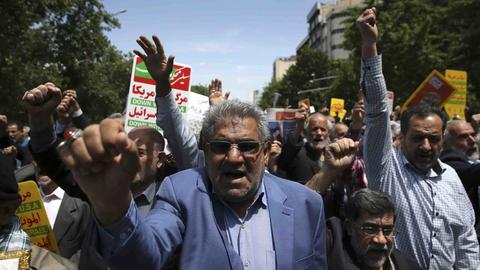
Hate speech against religious and other minorities in Iran surged last month as Persian-language online spaces endured a dramatic rise in state-facilitated hate speech targeting religious minorities.
Over 40,000 pieces of hateful content were identified – a spike of more than 30 per cent compared to February – and the spike coincided with heightened sectarian tension in Iran.
Sunni Muslims were the most targeted group in March, with an estimated 18,000 online hate posts monitored by IranWire analysts, showing a 115 per cent increase from the previous month.
State-run news agencies also published scores of articles and videos attacking – in direct, and often indirect or apparently neutral language – religious minorities. More than 1,500 such publications attacked Sunnis Muslims, with 488 anti-Semitic pieces published, 138 against Christian converts or heritage Christians, 55 targeting Baha'is and 29 against Iran's ancient Zoroastrian community.
Many of these posts are sparked by the Persian New Year of Nowruz overlapping with the Muslim holy month of Ramadan. Sectarian tensions in Urmia culminated in protests on March 21 – the day after Nowruz, which coincided with the anniversary of the Shia Imam Ali's death at the hands of Sunni forces in the 7th century – when anti-Sunni and anti-Kurdish slogans accompanied clashes between Sunni Kurdish and Azerbaijani Shia citizens.
For decades, the Islamic Republic has stoked sectarian tensions, a policy designed to keep various ethnic and religious minorities at each other's throats and less attentive to the human rights abuses of the Iranian government.
Agitation on the streets last month was mirrored with rising hate speech online linked to official and semi-official social media accounts and media outlets – revealing a direct link between street-level sectarianism and government-backed digital incitement.
Jews, Christians, Baha’is, and Zoroastrians were also frequent targets of online hate speech, with 15,000, 2,630, 2,600, and 1,680 hate speech posts monitored, respectively, by IranWire's tracking. State-linked sources often disguised anti-Jewish rhetoric as anti-Zionism – a common conflation by Islamic Republic propagandists and Iranian state media – and labeled Sunnis with language that used dog whistle techniques to signal antagonism without broadcasting outright hostile slogans.
And despite the volume of anti-Baha'i content remaining stable, over the month, much of the hate speech monitored by IranWire grew sharper in tone.
A major religious television show, “Mahfel," featured a supposed former Baha'i whose interview was broadcast with a backdrop labeled "The Repenter" and who repeated debunked conspiracies about links between the Baha'i Faith and Zionism. The broadcast also included unsubstantiated claims that the individual was harassed by Baha'is after converting to Shiism.
Media affiliated with the Islamic Revolutionary Guard Corp intensified these narratives by claiming, without proof, that Baha'is dominate Iran's economic life. The reality demonstrated by human rights groups, again and again, shows systemic bans and restrictions on their business activities and efforts to earn livelihoods.
Propaganda and hate speech against religious and ethnic minorities in March reminds us that the Islamic Republic weaponizes religious and ethnic animosity – in particular during politically or religiously sensitive periods. And as anti-minority rhetoric is laundered through official discourse and cultural programming, it not only reflects but also legitimizes deeper patterns of institutional discrimination; meaning, all this will happen again next month.

Interested in writing for IranWire?
Share your stories.




comments