



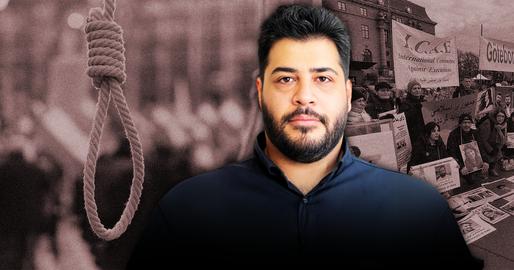
In the world of network security, Mohsen Langarneshin was a standout talent.
By 20, his skills had taken him to Imam Hussein University, where he spent two years securing systems for an institution linked to Iran’s military.
That same expertise would later lead to his death.
In the early hours of Wednesday, the Islamic Republic’s authorities executed the 34-year-old network security expert, despite international concerns about due process and torture.
Just hours earlier, his parents waited outside Qezelhesar Prison, his mother crying as an ambulance arrived - a sign of what was coming.
The execution followed months of legal proceedings condemned by human rights groups as deeply flawed.
At 4:30 AM on Wednesday, Langarneshin’s father posted a video on Instagram saying he had no news of his son and had heard he’d been moved to an unknown location - often the final step before executions in Iran.
By dawn, it was over. Authorities confirmed that Langarneshin had been hanged.
He was a network security specialist and car dealer in Tehran, arrested by Intelligence Ministry agents on July 3, 2023, outside his shop.
His death sentence, signed by notorious “death judge” Abolghasem Salavati of the Tehran Revolutionary Court and Ali Razini of the Supreme Court - who was killed earlier this year - convicted him of “spying for Israel,” a charge that legal observers say was based on coerced confessions.
What made Langarneshin particularly vulnerable was his previous work at Imam Hussein University, an institution affiliated with the Islamic Revolutionary Guard Corps (IRGC).
For two years, he had been sent there by a private company to upgrade the university’s computer security systems.
This professional connection would later be twisted into evidence of espionage.
He was accused of involvement in the 2011 death of Hassan Tehrani Moghadam, the father of Iran’s missile program, who died in an explosion with 39 others. Langarneshin was just 20 years old at the time.
More recently, prosecutors claimed he assisted in the 2022 assassination of IRGC commander Hassan Sayyad Khodaei by tracking him and providing information about his movements.
In a 21-minute audio recording obtained by IranWire before his execution, Langarneshin detailed the accusations, which included purchasing a Pride car, taking it to Isfahan, leaving it in a parking lot, and storing a package measuring 30 by 40 centimeters that allegedly contained explosives.
But the charges were full of contradictions.
Officials had long claimed that Tehrani Moghadam’s death was an accident during an ammunition transfer - a story repeated by top IRGC commanders like Hassan Firouzabadi, Ramadan Sharif, and Amir Ali Hajizadeh.
While this narrative was briefly challenged in 2016 by Tehrani Moghadam’s brother in an interview with a publication close to the IRGC, and later in the TV series Gando, official statements continued to describe it as an accident.
Even in October 2024, IRGC commander Esmail Kowsari said on state TV that “Martyr Hassan Tehrani Moghadam was martyred while building an intercontinental missile,” without any mention of Israeli involvement.
One of the most troubling parts of Langarneshin’s case was the fake evidence and the ignoring of proof that could clear him. In an audio recording, he said interrogators insisted he owned a Honda 125 motorcycle used for surveillance. He denied it, saying he only had a brand-new Fidel 5.
“If I owned the motorcycle in question, its ownership documents should have been included in the case file,” he said.
His family submitted documentation of his vehicle ownership that did not include any Honda 125, but the court rejected this evidence.
Langarneshin also said he wasn’t in Tehran when Khodaei was killed - evidence backed by his phone records, which the court ignored.
A former cellmate of Langarneshin told IranWire about the contradictions regarding his work at Imam Hussein University.
“He was a genius in network security. Because of his expertise, they took him to Imam Hussein University for a while to handle their network security work.”
“He was under a lot of pressure to say he went there to identify the university’s forces. Whereas they had taken him there themselves.”
The audio recording that reached media outlets before his execution paints a harrowing picture of systematic torture and psychological manipulation.
Langarneshin described being held in a safe house after his arrest, where interrogators threatened to flog and torture him if he didn’t write exactly what they dictated.
After spending 43 days in solitary confinement, he was repeatedly threatened that the women in his family - his mother, sister, and fiancée - had also been arrested and would be detained until they were “no longer recognizable.”
Langarneshin described being taken to a wooden bridge at 6 AM with armed officers, where he was forced to participate in a reenactment of Sayyad Khodaei’s assassination for filming.
“After threats and pressure from the officers, I was forced to say whatever they told me,” he recounted.
The psychological torture reached extreme levels when security forces staged a mock execution to break his resistance.
“When I resisted confessing, they took me to a school in Evin’s grounds. They handcuffed and leg-cuffed me, blindfolded me, and filmed me.
“They said this is the film before your execution, and you will be executed in a few days. They said if you write this, maybe our hearts would soften and we would commute it to life imprisonment.”
Authorities denied him medication for his epilepsy.
“In the first month of detention, they cut off my neurological medications and told me to tell my family they were giving them to me if they asked.
“If you tell the truth, we’ll cut off your calls. During that month, I had frequent seizures, the effects of which are still present after a year.”
This is not the first time that the Islamic Republic’s security agencies have subjected elite individuals to severe punishments of imprisonment or even execution on charges of espionage.
Maryam Haji Hosseini, a materials engineer with numerous awards, was arrested in September 2019 and subjected to 412 days of solitary confinement and torture to confess that she had “provided Israel with Iran’s scientific and military information.”
Over the past decade, Iran has arrested and imprisoned dozens of scientists, academics, and tech experts on dubious espionage charges, often targeting those with connections to military institutions or dual nationals with ties to Western countries.
Human rights groups have documented a pattern where these individuals are arrested, held incommunicado, denied legal representation, subjected to physical and psychological torture, and forced to make televised confessions before receiving harsh sentences in closed trials.
Beyond the security paranoia, there appears to be a financial component to these cases. In addition to the espionage charges, Langarneshin faced financial accusations, specifically receiving 122,000 euros from Israel.
In his testimony, he described being taken to various parks in Tehran, where officers forced him to say on camera that he had received varying sums of money in different locations.
“They took me out one night and kept me on the street until seven the next morning… telling me to say in front of the camera that I received $5,000 here, $10,000 there.”
These financial charges often result in asset seizures, raising questions about whether some prosecutions may be motivated partly by the opportunity to confiscate valuable property and assets.
For Langarneshin’s family, the nightmare continues beyond his death.
Families of executed prisoners in Iran often face restrictions on mourning ceremonies and burial locations and sometimes encounter pressure to remain silent about the circumstances of their loved ones’ cases.

Interested in writing for IranWire?
Share your stories.


comments