



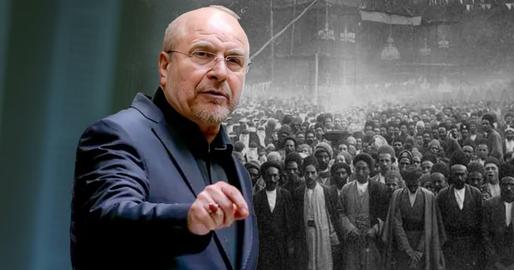
On the 119th anniversary of Iran’s Constitutional Revolution, Mohammad Bagher Ghalibaf, speaker Iran's parliament, declared that the Islamic Republic is the “rightful heir” to that revolution. He went further, invoking religious overtones by claiming the revolution was guided by the Islamic faith of the masses and praising Sheikh Fazlollah Nouri - an ardent opponent of constitutionalism - as a martyr for the cause.
These statements are not only historically inaccurate but deeply ironic. The Islamic Republic, by its very structure and ideology, stands in direct contradiction to the core ideals of the Constitutional Revolution. To claim its legacy is a gross distortion of history.
A Revolution for Accountability, Not Theocracy
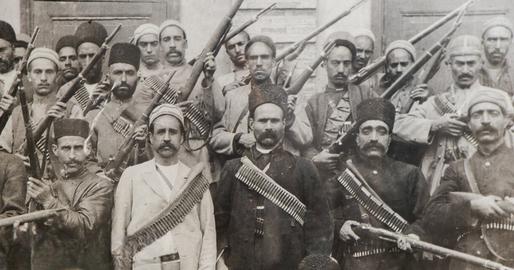
The Constitutional Revolution of 1906–1911 was a watershed moment in Iran’s history. It sought to establish the rule of law, limit royal absolutism, and introduce a representative parliament - a Majles - as a check on power.
It was born out of a collective desire for justice, transparency, and the end of arbitrary rule by the Qajar monarchy. It was not a religious uprising but a political one.
While many religious scholars supported the movement early on, it was a diverse coalition of merchants, intellectuals, secular reformers, women’s rights advocates, and members of persecuted religious minorities - particularly Azalis, Babis, and Baha’is - who played key roles as revolutionaries and thinkers.
The irony is stark: the very revolution that sought to limit unchecked power is now being claimed by a regime built on velayat-e faqih - the guardianship of a single unelected jurist with unchecked authority.
The Islamic Republic’s Supreme Leader sits above any form of democratic oversight, immune to public scrutiny or legal restraint. How can such a system, rooted in theological supremacy and political opacity, dare to invoke the memory of a revolution that died trying to institutionalize accountability?
Clerical Opposition
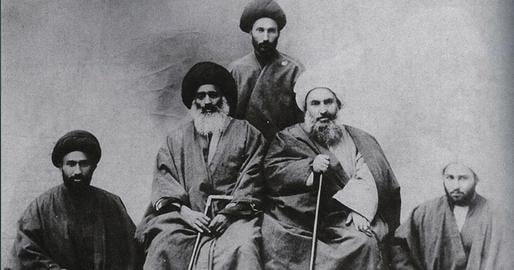
If there is a faction historically responsible for derailing the Constitutional Revolution, it is precisely the one now attempting to appropriate its legacy: the clerical establishment. Sheikh Fazlollah Nouri - praised by Ghalibaf - was not a champion of constitutionalism but its sworn enemy.
He denounced the constitution as an affront to Islamic law, publicly opposed the separation of powers, and declared modern notions of citizenship and equality as heretical.
His alliance with the Qajar monarchy and Russian-backed reactionaries reveals him as a traitor who helped ignite a brutal civil war that nearly annihilated the nascent constitutional order. To label him a “martyr of the revolution” is to rewrite history.
Nouri’s execution was not for advocating faith but for actively working against the constitutional government and inciting violence. His legacy is one of sabotage, not sacrifice. His ideological descendants - those who now run the Islamic Republic - continue that tradition of suppressing democratic aspirations and concentrating power in the hands of a few in the name of religious orthodoxy.
Where the Real Revolutionaries Stood
It is crucial to remember that the earliest and most consistent proponents of constitutionalism were vocal participants, authors, and activists who envisioned a modern, inclusive Iran governed by principles of justice and human dignity. These groups, often accused of heresy by the clergy, were systematically targeted for their progressive ideals.
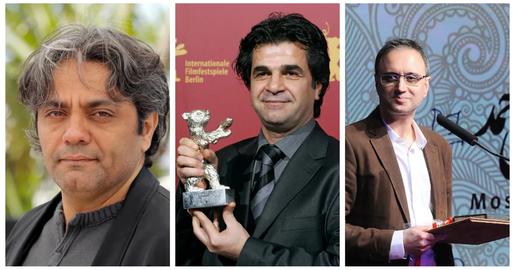
The dissidents of today are the modern counterparts of the Constitutional Revolution - and the clergy of today, much like the clergy of 119 years ago, continue to deny them basic rights, education, freedom, and legal protection.
Not Even a Caricature
The Islamic Republic is not the heir to the Constitutional Revolution. It is not even a distorted caricature. It lacks the hallmarks of that revolution: power-sharing, legal reform, civil participation, and institutional accountability. In today’s Iran, dissent is criminalized, the press is muzzled, and political participation is an illusion.
The judiciary operates under the thumb of political and religious power, while elections are filtered through a vetting process - the Guardian Council - that ensures only regime loyalists can run for office.
If the constitutionalists of 1906 were alive today, they would find themselves imprisoned in Evin, their newspapers shut down, their speeches branded as threats to national security, and their beliefs as an affront to God. To claim their mantle while violating every principle they fought for is not homage - it is betrayal.
Conclusion
The Islamic Republic’s attempt to appropriate the legacy of the Constitutional Revolution is historically unfounded and morally bankrupt. It was not Islamism but pluralism - not clericalism but constitutionalism - that animated the revolution of 1906. It was derailed by the very ideology that now seeks to claim it.
The real heirs of the Constitutional Revolution are those who still fight for a free press, independent courts, minority rights, and a transparent government. They exist - not in parliament, but in exile, in prison, and in the hearts of millions who know that the revolution remains unfinished.

Interested in writing for IranWire?
Share your stories.






comments