



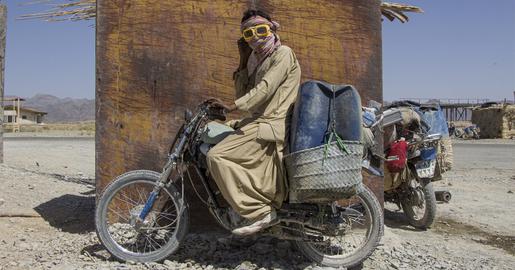
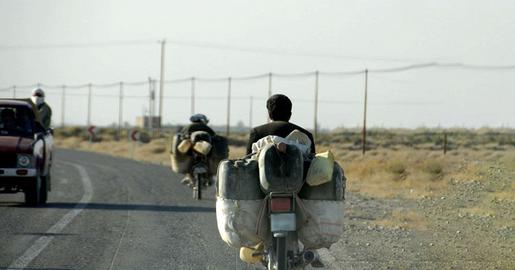
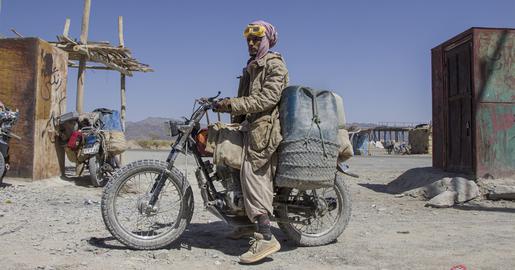
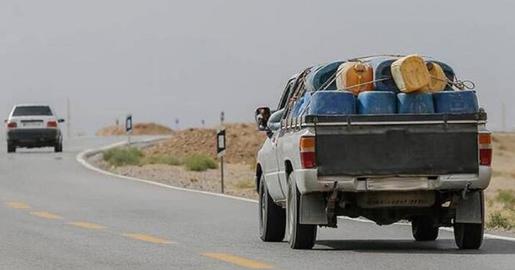
A beat-up Toyota pickup truck speeds along a desolate road in the middle of the desert, its rear weighed down with jerry cans full of fuel.
Inside, Mohammad Noor, 35, grips the steering wheel tightly, his eyes darting between the road and the rearview mirror.
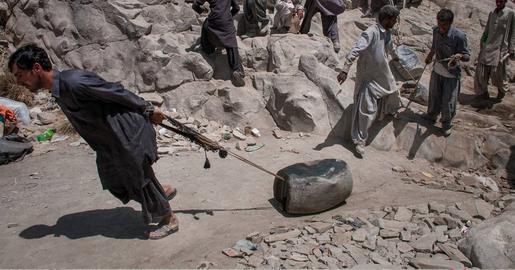
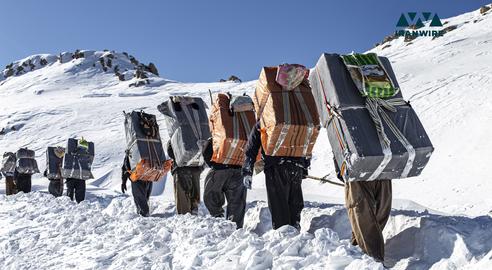
In Sistan and Baluchistan province, Iran's southeastern region, fuel carrying has become a desperate means of survival for many Baluch citizens.
The dangerous practice of carrying fuel across the border reflects the dire economic situation faced by the Baluch community amidst government neglect, systemic poverty, and discrimination.
According to a report by the human rights media outlet Haalvsh, 366 Baluch citizens lost their lives while transporting fuel in 2023 alone.
Many of these deaths resulted from direct shootings by border guards, while others occurred in accidents during high-speed chases as fuel carriers attempted to evade authorities.
The Baluch Activists Campaign reports that in the first six months of 2024, the number of killed and injured fuel workers increased by over three per cent compared to the same period in the previous year.
This rise is attributed to escalating government violence in Balochistan, particularly intensified policing measures.
Despite the extreme risks, an increasing number of young people, and even children in recent years, are turning to fuel carrying as their only means of income.
Many who survive face severe, often irreversible injuries.
Mohammad Noor, a 35-year-old fuel carrier from Dashtiari, has been forced into the hazardous job since he was 15.
He tells IranWire how the age of young workers has decreased dramatically in recent years.
"Last night, I saw an 11-year-old boy who said he dropped out of school because he had to support his family," he recounts. "I told him to go study, but he said he had no choice."
Twenty-two-year-old Matin from Khash vividly remembers starting as an apprentice fueler at 14.
He says, "Most teenagers and young people now deliver fuel. Many can't study because there are no schools or they can't afford it."
Matin, to spare his parents' worries, told them he was a bakery apprentice.
"They don't know I still carry fuel," he says. "They would be devastated knowing how many young people have died doing this."
Matin recounts a night when a fuel carrier in front of them collided with another, catching fire.
"The driver was screaming that the steering wheel was stuck in his chest," he says. "Despite our efforts, we couldn't save him. He burned alive, and the sound of his head exploding still haunts me."
This was not the only time Matin witnessed such a tragedy.
The frequent deadly accidents have left him and many others traumatized. "If officials in our province created jobs, we and our families wouldn't need this dangerous work," he says.
The death toll among fuel workers in Baluchistan continues to rise, with young people and even children increasingly drawn to this perilous job.
Four of them died last month in a collision, including an 11-year-old boy named Rezvan Dehani.
Mohammad Noor knows that every trip he makes could be his last. Dealing with large amounts of petrol, he faces constant danger.
"I've been shot at multiple times," he says, describing an area called Kapkar, where border forces are stationed every 100 meters. "We have to wait for hours for the soldiers' shift to end, then cross at high speed. They shoot at us."
But being shot at isn't the only hazard.
He has been arrested and beaten numerous times. "I begged them, saying I was just a fuel carrier, but they treated me like a murderer," he recalls.
Faced with limited job opportunities, he feels trapped.
"What should I do? There is no other job. If there were, they wouldn't give it to a Baluch like me. They don't hire us in public or private offices."
He recently witnessed the deaths of three young men. "Three days ago, three young men were burned alive before my eyes. Last year, two of my mother's cousins were burned to death. When the fire went out, they were pulverized. Their images are still vivid in my mind."
The dangers aren't just physical.
He points to systemic issues, accusing government and military institutions of running a fuel smuggling mafia.
"The government itself is involved in smuggling, using tankers that are refuelled directly from neighbouring cities. No one inspects them. Hundreds of tankers carry fuel from the refinery daily."
His dream was to study and find a different job. "I am very talented," he says. "I wanted to study and have another job, but what can I do? I have to carry fuel because there's no other way to support my family."
The plight of fuel carriers in Balochistan is a dire one, where daily survival is a constant struggle against violence, systemic corruption, and lack of opportunities.
Arezo's (not her real name) life changed forever when her husband, a young fuel carrier, was shot by Iranian border guards four years after their marriage. They had a two-year-old child at the time.
"My husband had to carry fuel because there is nothing else for Baluch people to do," she says. "He was the breadwinner for several households, covering expenses for his mother and sick sister. The night he said goodbye was my son's second birthday. Because we were alone, he left us at my aunt's house before he left."
"Not even half an hour had passed when I got a call to go to the hospital. When I arrived, I found my husband's body with a bullet in the middle of his forehead."
His friend explained that after dropping Arezo and her child off, he was heading to the border with their empty car.
"They didn't even get to pick up the car, they were shot at with an empty vehicle that had nothing in it. After we complained, the authorities said it was a mistake. Now, I am left alone with a child."
Nasim, (not her real name) the young wife of a Baluch man who was burned alive in a fire, recounts the heart-wrenching story of her husband's death. His nephew met a similar fate.
She says how her husband, once an apprentice in a shop, turned to carrying fuel because his income was insufficient.
"We struggled for years. Every time he left, I was sleepless with stress and worry until he returned. On the night of Eid al-Adha, he called and said, 'I've arrived. I'll empty the load and return. This is the last time.' But at seven in the morning, he crashed and never came back, leaving me with two children."
Tareq, whose brother was killed by police gunfire, recounts: "For a few litres of petrol, the 12th Chabahar police station chased him. Despite knowing he was just a fuel carrier, they shot at him until he lost control of the car. It hit a bridge and caught fire."
Ali, the nephew of another fuel carrier, tells a similar story: "My uncle transported fuel with a Toyota. Five kilometres from Zabul, officers shot at him, hitting the tyre.
"He crashed, and the car caught fire. The officers fled. We complained, but they denied it and threatened that if we didn't withdraw the complaint, the body would stay in the morgue for ten days."
Ali adds, "My cousin also had an accident when officers shot him. This time, the officers didn't run away and admitted to the shooting, but still, there were no consequences.
"When they know someone is moving a few litres of petrol but still shoots, who can we complain to? Does Baluch life mean anything to them?"
The stories of many fuel workers and their families reveal a troubling reality. Many of the young men are educated and employed but forced into carrying fuel due to insufficient incomes and the crushing expenses of daily life.
Among the tales is that of Vajed, Adam, and Abdul Vahid, three of the four fuel carriers who died last month.
Adam's relative says that he was just 19 years old and the breadwinner for his several siblings, including a disabled brother.
"They were financially struggling, so he had to do the job," the relative explains.
On a Tuesday last month, Adam and Abdul Vahid were carrying fuel when their car collided with another vehicle.
Vajed lost consciousness inside the car, and Adam, attempting to rescue him, was engulfed in flames when the car exploded.
Despite rolling on the ground to extinguish the fire, Adam succumbed to his injuries three days later with 80 per cent burns. Abdul Vahid also died, at only 21 years old.
The tragedy is even more poignant as Adam and Vajed were second-semester university students.
Vajed, described as a bright student, worked from a young age due to his family's financial struggles.
He juggled his studies with carrying fuel and apprenticed in a small shop, always hoping to alleviate his family's sorrow.
Now, their families are shattered by their loss.
Another fuel carrier, a soldier with a bachelor's degree, says of a similar plight. "My two brothers and I have to carry fuel because there are no factories, government companies, or even jobs in our area," he says.
Despite his education and military service, he is forced into this dangerous work.
"The livelihood of our people depends on the border and fuel transportation. We have no other choice. If we had jobs with fixed salaries and insurance, we wouldn't do this dangerous work.
"Look at cities like Tehran, Isfahan, Shiraz, and Mashhad. They don't have the natural resources Baluchistan has, yet they have plenty of factories. But Balochistan, which holds half of the country's resources, lives in poverty."
Police and provincial officials often blame the high speed of fuel carriers for accidents and fatalities.
However, Ali, a fuel carrier, explains that the high speed is driven by fear of being caught by the authorities.
"If they catch us and take our car, we can no longer work. We buy these cars with loans and pay in instalments. If the agent seizes the car, we can’t work or pay the instalments. How will we cover living expenses? Then we spend days on the road to reach the border, earning barely enough after car expenses. In the end, we’re left with just a million tomans ($18).”

Interested in writing for IranWire?
Share your stories.







comments