



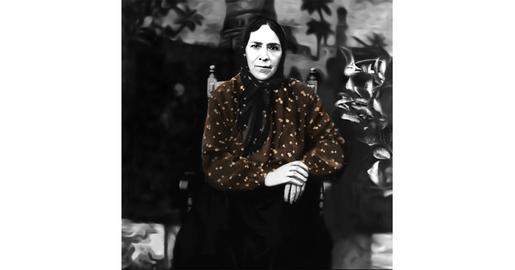
It has been more than half a century since Forough Azarakhshi passed away, but there are still women in the north-eastern city of Mashhad who have not forgotten her and mention her name with utmost respect. She established the city’s first girls’ school at her own expense and made it possible for girls in Mashhad to get an education by standing up against the patriarchal and reactionary members of the clergy. For two years, she and her associates took up arms and guarded the school day and night to prevent traditionalists from setting it on fire. In recent years, the Islamic Republic closed down the school that bore her name but the people kept her memory alive by keeping calling the alleyway where the school was located Forough Alley.
The Royal Descent, Four Sons and Three Daughters
Forough Azarakhshi was a descendant of the second king of Qajar dynasty, Fath Ali Shah (d. 1834), who had countless wives and even more numerous children. Her grandfather Shoja ol-Saltaneh was Fath Ali Shah's second child and his mother was Marzieh Khanum Gharaei, the daughter of the Khan of the Gharaei Tribe in Khorasan province. He had only one son who was given the honorary title of Ghahreman Mirza (“Prince Hero”) because of his bravery.
As a young man, Ghahreman Mirza married Soghra Khanum (Bibi Jaan), and Forough whom they called Forough ol-Saltaneh (“Light of the Realm”) was born in 1881 in the village of Azghand in Khorasan province. She was born around the time Mirza Hassan Roshdieh, a progressive cleric, was pioneering modern schools in Iran.
Roshdieh attempted to open two schools in Mashhad but failed to overcome the opposition of the traditionalists and the religious establishment, so he went to Tehran where he founded the capital’s first modern school. Following the opening of this school, efforts to establish modern schools spread to other Iranian cities as well. Girls, of course, were not the targeted beneficiaries of these efforts and the schools were mostly for boys. Nevertheless, Forough and her sister Banu learned reading and writing in such a school.
Forough was 17 when the family married her to Brigadier General Ali Akbar-Khan Azarakhshi, a young man from Tbilisi, Georgia, a province of the Russian Empire at the time, who was the head of telegraph office at the Russian Consulate in Mashhad. They had four sons and three daughters, but the demands of family life did not stop her from working to open up the world of education to girls. The birth of her first daughter Aziz ol-Molk gave her a strong motive to work for establishing a girls’ school in Mashhad. Her acquaintance with women’s rights activists in Tehran such as Fakhr-Afagh Parsa gave her more confidence in following her goal.
Building the School and Guarding It with Guns
In 1917, after studying educational policies for girls, Forough talked about her ideas with her husband who supported her and discussed the matter with cultural figures. Then, with the help of figures such as Haj Morteza Ghahreman Mirza, also known as Shekasteh, a poet and journalist who also held administrative jobs in the province, the construction of the first girls’ school in Mashhad started.
Construction took more than three years to complete. “The school building had a raised platform with five rooms with half-wooden half-glass windows and sufficient light facing a garden,” Forough’s daughter Aziz ol-Molk Azarakhshi said of the building. “There was a wide, long corridor connecting a big yard to a smaller one, which then opened onto an alleyway. To enter the school, one had to cross the small yard, and walk through the long corridor to reach the larger yard where the school building was situated. The headmistress' office was in the smaller section, with another room between her office and the corridor. There were three rooms and a toilet opposite. The third room belonged to the janitor, which had a backroom. There was a pool with two middle-sized flower beds in the middle of the yard."
According to historical sources, three girls were enrolled in first grade and four in the second when the school opened. Although the school was set up discreetly, news of its opening quickly spread across Mashhad and opponents soon started to issue threats. Each day, Forough and her family received threats that if they did not close down the school they would kill her and her associates and would set the school on fire. But Forough did not back down. Each day, she guarded the school with teachers and her children, brothers and servants, some of whom were armed.
In the first few months after the school opened, the number of students rose and very soon it offered third, fourth and fifth grades as well. Seven candidates sat the fifth-grade exams, and all of them passed. After four years the number of students grew large enough for the school to offer sixth grade too.
The expansion of the school, although encouraging, created further problems for Forough. As the school was privately financed, it gradually faced budget deficits and suffered from a lack of facilities. To remedy these difficulties, Forough appealed to the Khorasan Institute of Culture for financial assistance. In addition, Ahmad Qavam, also known as Qavam os-Saltaneh, the governor of Khorasan who later became prime minister, donated 2,000 rials to the school, allowing Forough to keep the school functioning and to expand it.
The school's success continued, and the number of pupils began to rise rapidly. In 1925, there were 145 young girls studying at the Forough School, 27 of them paying no tuition. Well-known educators, including Fakhr-Afaq Parsa, taught there. Her daughter Farokhru Parsa studied at the school and later became the first woman minister of education in Iran.
A year after the school opened, Forough established another girls’ school in Mashhad and asked her sister, Princess Banu Ghahramani, to administer it. This school was located in Bala Street on the Sheikh Abdol-Hossein Alley in a house rented for 300 rials per month. Forough and her sister funded the school mainly by themselves.
A “Servant of Our Culture”
The opening of the second school encouraged others to follow suit and, within a few years, the Arz-e Aqdas, Esmatieh, Ezzatieh, and Goharieh girls’ schools were opened in Mashhad.
In 1932, Forough applied for a permit to open a girls’ high school at the Khorasan Department of Education. It was proposed that the school be run as a state school in order to circumvent various problems. By 1934, the school expanded and two more grades were added to the first grade.
In 1948, Forough Elementary School in Gonbad Sabz Street in Mashhad became a state school, but it still bore the name Forough on its entrance.
Forough remained the principal of the school until 1956, when she retired after 40 years of invaluable service. Her retirement was marked by a ceremony to celebrate her accomplishments.
"The ceremony was attended by the governor, deputy custodian [of Imam Reza's Shrine], heads of various offices, teachers, as well as a large number of people from different social classes,” says an article published in Aftab-e Shargh newspaper on December 11, 1956. Addressing the audience, a senior member of Khorasan Department of Education by the name of Kosari provided a detailed account of Forough’s decades of service and announced: “Our culture will always be proud of her and she will remain in the heart of culture and academia forever."
At the ceremony, Azarakhshi’s grandson Mohammad Vali Ghahraman read out a text written by Azarakhshi: "For an old servant like me, I am very grateful that you came here today…when I opened the Forough School, my hope lied in God's mercy and the respectable people of this city. Fortunately, soon it became clear that it was not a vain hope, because despite the slanders and reproaches pouring on the heads of our staff from all directions, people were sending their children to school. Today I am very happy that, although I have no strength in my feet and no light in my eyes, you have become the light of my eyes and burning candles of a loving family. On my last day of serving culture, while being grateful for your love and grace, I assure you that I will remain a servant of our culture as long as I live."
Forough Azarakhshi died in December 1963 in Mashhad and was buried in Imam Reza's Shrine. Her students attended her funeral.

Interested in writing for IranWire?
Share your stories.


comments