



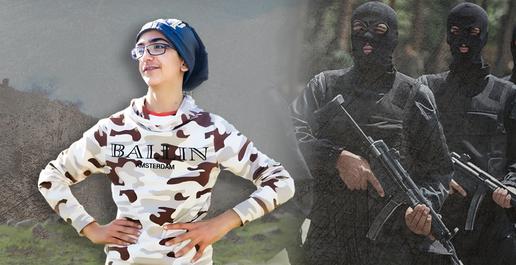
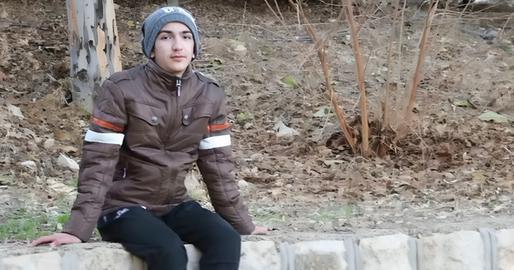
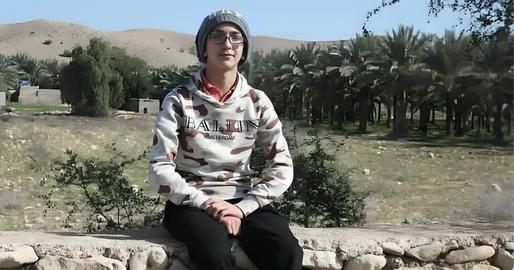
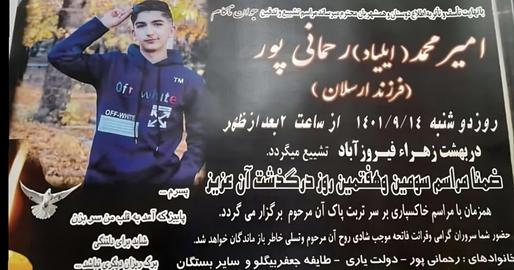
Amir Mohammad Rahmanipour was a 17-year-old who disappeared on November 29, 2022, during the Woman, Life, Freedom protests in Iran's Fars province. Three days later, his lifeless body was discovered, with a glass of alcohol and sleeping pills found nearby, suggesting an apparent suicide.
The government and security forces denied any responsibility for his death, claiming he had taken his own life using pills and alcohol. However, his family has consistently rejected this narrative, saying that their son was neither an alcoholic nor depressed. They emphasized that Rahmanipour was a hopeful protester, determined to see change.
His family believes that Rahmanipour was tortured and killed while likely in the custody of security forces. His mother described the wounds on her son's body in her cries, while his aunt recounted how the lower half of his body had been burned with cigarettes.
On the second anniversary of the nationwide protests following the death of Mahsa Amini in the custody of Iran's notorious Morality Police, IranWire published a series of reports on the victims of the crackdown on protests, the legal battles their families have faced, and what has transpired since their loss.
Rahmanipour was an 11th-grade student. Passionate about music and martial arts, he held a black belt in taekwondo. After Mahsa Amini died in custody, he began posting protest stories on his Instagram page.
His aunt, Nasrin Dolatyari, who lives in the Netherlands, describes him as "very calm and quiet; he rarely spoke unless asked a question."
Despite his reserved nature, Rahmanipour joined the growing wave of protests, driven by the same desire for a normal life that moved thousands of other teenagers to the streets.
In their small town of Firouzabad, protesting was a significant risk. However, Rahmanipour took to the streets, which likely led to his identification and arrest by security agents. Three days later, his lifeless body was found at a bus terminal near their home.
Dolatyari told IranWire that days before his body was discovered on November 29, Rahmanipour had been ill with a cold. His mother had taken him to the doctor, and on the way back, he told her, near their house, to go on without him. That was the last time she saw him.
That night, when the family gathered for dinner, they found that Rahmanipour's phone was turned off. Concerned, they reached out to friends and relatives and reported his disappearance to the police.
According to Dolatyari, the family was informed of Rahmanipour's body being found through an unknown phone call. "He was found sitting with his hands in his pockets, a number of pills, and a glass of alcohol in front of him. His face was bruised, indicating he had been beaten."
The killing of protesting children during the protests has made headlines multiple times. One of the most prominent cases is that of Nika Shakarami, a 16-year-old protester who disappeared on September 20, 2022, after participating in demonstrations in central Tehran. Nika disappeared for two days before her lifeless body, showing signs of severe beating, was discovered and given to her family at a morgue.
Initially, Tehran's prosecutor claimed that Nika died after falling from the roof of a building near her aunt's house and asserted that her death was unrelated to the protests. She was sexually assaulted before being killed by security officers, according to a report by the BBC.
The authorities of the Islamic Republic continue to insist that Rahmanipour's death was a suicide. However, less than three months before the second anniversary of his death, his aunt reported seeing numerous bruises and injuries on the teenager's body, which she believes indicate that he was tortured while in custody.
She describes the extent of the abuse: "They tortured him severely. His body was burned from the waist down with a cigarette butt. There were many bruises and wounds on him. My sister is in tears, and she says her child's body was completely scarred."
The aunt asserts that Rahmanipour was neither depressed nor an alcoholic who would have committed suicide using alcohol and pills. She emphasizes that her 23-year-old son, who grew up in the Netherlands, saw Rahmanipour's protest stories and questioned their authenticity, noting that he was an athlete and made music in English. "They staged it," she said.
She also recounts difficulties in obtaining Rahmanipour's phone, which was returned a year later, wiped clean of any data. "It was empty. There was nothing on his phone," she added.
In recent years, families of those killed in protests or executed have faced severe persecution, including job and university dismissals, arrests, legal cases, long-term imprisonments, property confiscation, and threats.
Nasrin Dolatyari describes her sister's suffering, saying that she cannot find peace and spends her days washing Rahmanipour's grave and repeating the process daily. "The pain is immense," Dolatyari explains. "My sister’s condition is truly dire. There is no peace, no respite. I call, but I'm not there. There is nothing I can do."
Rahmanipour had two sisters and was the only son. Dolatyari said that his sisters also endure significant hardship: "One sister has a degree in computer science and is unemployed, while the other is studying medicine and has not yet completed her studies. The older sister has searched everywhere for work but has been consistently rejected. Despite promises of future employment, no job has been given to her even though she has the necessary qualifications."
Dolatyari said that the family is under intense pressure and is concerned about their phones being monitored, which limits their ability to share information. "My sister once expressed a desire to sit with me and share her feelings and pain, but we are not fully aware of the situation," she said.
Regarding the pressure on her, Dolatyari said: "Everyone asked me why I gave an interview. I responded that he was like my own child. If I remain silent, I betray him because the situation has become critical. It's the only thing I can do."
On the judicial follow-up of Rahmanipour's case, Dolatyari explains: "The family cannot discuss it openly, but as far as I know, the agents themselves conducted the autopsy. The report claimed the cause of death was poisoning, which led to the closure of the case."
Forensic medicine in Iran is affiliated with the judiciary and is overseen by the leader of the Islamic Republic. Although it has issued relatively independent reports in the past, it has cooperated with security and judicial institutions, especially during the Woman, Life, Freedom Movement and the death of 22-year-old Mahsa Amini in the custody of the Morality Police.

Interested in writing for IranWire?
Share your stories.



comments