



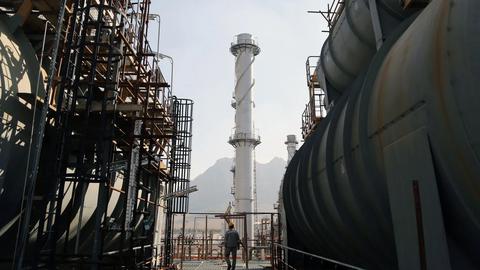
On November 25th the Elva, a tanker flagged in São Tomé and Príncipe, clandestinely picked up 2m barrels of Iranian crude off Malaysia’s coast. Sailing from there to north-east China, the vessel’s likely destination, usually takes two weeks at most. But not this time. On December 3rd, alleging the Elva had breached sanctions, America blacklisted the ship, exposing anyone dealing with it to punishment. Six weeks on it is still stranded less than 20km from where it collected its cargo, the Economist newspaper writes.
The Elva has company. Since October, when the Biden administration started cracking down on Iran-linked tankers, their crude deliveries to China, which buys nearly all of Iran’s oil, have shrunk by a quarter, to 1.3m barrels per day (b/d). At the same time, loadings from Iran have continued apace, in the hope of a change of circumstances. The result is that there is now four times as much Iranian oil stranded at sea—20m barrels—most of which sits off the coasts of Malaysia and Singapore.
On November 25th the Elva, a tanker flagged in São Tomé and Príncipe, clandestinely picked up 2m barrels of Iranian crude off Malaysia’s coast. Sailing from there to north-east China, the vessel’s likely destination, usually takes two weeks at most. But not this time. On December 3rd, alleging the Elva had breached sanctions, America blacklisted the ship, exposing anyone dealing with it to punishment. Six weeks on it is still stranded less than 20km from where it collected its cargo.
The Elva has company. Since October, when the Biden administration started cracking down on Iran-linked tankers, their crude deliveries to China, which buys nearly all of Iran’s oil, have shrunk by a quarter, to 1.3m barrels per day (b/d). At the same time, loadings from Iran have continued apace, in the hope of a change of circumstances. The result is that there is now four times as much Iranian oil stranded at sea—20m barrels—most of which sits off the coasts of Malaysia and Singapore.
In the final days of the Biden presidency America is striking Russia, too. On January 10th officials announced new sanctions against 143 tankers, accounting for 42% of Russia’s seaborne oil exports last year, as well as large exporters and insurers. This will cause headaches in the short term for Vladimir Putin, and is one reason why Brent crude, the global benchmark, hit $81 a barrel on January 13th, its highest in five months. Yet it is Iran that faces the bigger threat. Donald Trump remains ambivalent about blockading Russia but is committed to strangling Iran’s finances. He might well succeed, and in doing so disturb global energy markets.
For most of his tenure Joe Biden turned a blind eye to Iran’s burgeoning oil trade. Between 2018, when the first Trump administration reimposed harsh sanctions, and last year, the country’s crude exports grew twelvefold to 1.8m b/d. Then, in October, Mr Biden changed tack. In the months since, America’s Treasury has added 55 tankers to its Iran-linked blacklist, equivalent to a third of the “dark” fleet tasked with carrying Iran’s crude, says Homayoun Falakshahi of Kpler, a data firm.
People familiar with the administration say officials have realised that their lenient approach towards Iran has failed. Iran has been weakened not by sanctions but by Israel’s victories over Hamas and Hezbollah, as well as the fall of Bashar al-Assad in Syria. It is also close to building a nuclear weapon. Meanwhile, global oil supply is plentiful and demand weak, making it less likely that sanction enforcement will hurt American consumers. In any case, more expensive petrol will henceforth be Mr Trump’s problem.
Read the full article here.

Interested in writing for IranWire?
Share your stories.









comments