



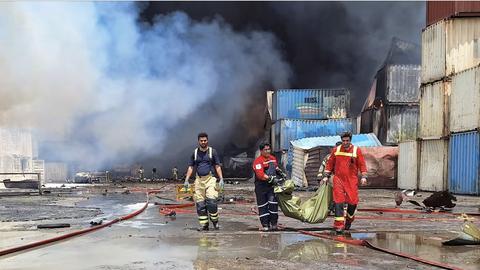


Five days after the explosion at Shahid Rajaee Port, the air still smells of chemicals and loss.
Beyond the official death toll of 70, locals say many migrant workers remain missing. Without papers, without records, without witnesses, these men from Iran's impoverished provinces have become invisible - even in death.
One man who survived now stands among the ruins.
"Many people went missing," he says. "Many of my colleagues whose names aren’t registered anywhere because most of them were migrant workers without identification papers, taking whatever work they could find just to earn a living."
"Who should I tell you about? Qader and Saeed, or Jasem and Hamidreza?" he adds. "None of them even have a single shoe left."
Musa survived by what he can only describe as a miracle. Half an hour before the catastrophic explosion, his brother called with news that their father had fallen ill.
"I quickly took hourly leave," he recalls. "It was difficult to get permission because it was loading time, but since it was close to lunch hour, the supervisor let me go on the condition that I return after lunch."
While Musa sat at his father’s bedside, the port where he had worked for years became ground zero for Iran's deadliest industrial disaster in recent memory.
Originally from Khormoj in southern Bushehr, Musa represents the face of Iran's vast migrant labor force - men who travel hundreds of kilometers from impoverished regions to find work in industrial hubs.
His colleagues came from villages scattered across Bandar Abbas, Kerman, and the disadvantaged Sistan and Baluchistan province.
"Mostly people from Shirabad, Lutak, and villages in Saravan and Sarbaz," he explains. "Workers who didn’t even have a place to stay would sleep in the port area and around the docks in the heat of this port."
These men worked in the shadows - no contracts, papers, or recognition.
"It’s not that they had no one," Musa insists, pushing back against the notion that these men were forgotten entirely.
"But who will answer for them? Some families don’t even know where they work. They’re not among the port’s registered workers. Nothing has been found of them. Several families came and returned empty-handed."
His voice breaks with emotion, and he falls silent. Some burdens are too heavy to carry in words.
According to state media, more than 70 people died in the explosion, with 22 reported missing.
Official numbers appear in statements, news reports, and briefings - but the situation on the ground tells a different story.
Local sources and witnesses suggest the actual number of victims, particularly among day laborers working for Sina and Beta companies and other warehouses, was significantly higher.
The explosion has drawn comparisons to the Metropol collapse, another case where undocumented workers vanished, forgotten in both life and death.
Esmail Hajizadeh, head of the Workers' House in Hormozgan, confirmed the overlooked casualties.
"It’s unclear how many Baluch and Sistani day laborers have died. A meeting was held yesterday at the Labor Department to follow up on this issue."
The bureaucratic language fails to capture the human tragedy.
"Some of these workers may not have had identification papers," Hajizadeh adds, "but the issue is even those who did often didn’t carry them on the job."
"Moreover, the identities of day laborers aren’t registered, and they don’t have fixed employers. These workers were involved in loading and unloading, and there’s no list of them anywhere."
A spokesman for the Islamic Republic's parliamentary National Security Commission said that initial findings show no foreign involvement in the Shahid Rajaee Port explosion.
"Based on reports so far, the blast had no external origin," Ebrahim Rezaei said Tuesday after a committee briefing.
He noted that investigators had found evidence of “negligence and failure to observe safety protocols” at the site, which now requires further expert review.
Lawmakers Ahmad Ajam and Sara Fallahi, sent by the National Security and Foreign Policy Committee, submitted their preliminary report to parliament on Tuesday following a visit to the port.
Former Iranian lawmaker Ali Motahari told state media that a company linked to the Bandar Abbas explosion had likely misdeclared hazardous cargo as ordinary goods to cut costs.
"What do officials mean when they say the cause of the accident was just negligence and non-disclosure by one company?"
The question comes from a young man who introduced himself only as Amin, a pseudonym used to shield him from potential repercussions for speaking out.
His tall, kind brother was a forklift driver at Sina Company.
"Is Rajaee Port so unregulated that an ordinary company can import a series of containers, declare chemical materials as low-risk, and not face inspection or provide documentation?" Amin asks.
"Who do they think they’re fooling? Sina Company has a reputation - it’s not some anonymous firm no one’s heard of to say they don't know who's responsible."
For four days, Amin has wandered across what he describes as "melted iron."
"My dear, tall, and kind brother worked as a forklift driver in the Sina Company area," he says. "Do you know which one that is? You must have seen the explosion video. Three warehouses side by side were destroyed instantly. My brother was in one of those warehouses at the time of the explosion."
Amin has watched the video countless times. "I've seen it a thousand times, always wondering where my brother was and what he was doing."
The search for answers has consumed his family.
"We’ve been around the port for four days. My mother has been holding my brother’s wedding photo and asking everyone about him. We’ve searched the hospitals one by one."
Neither the hospitals nor the forensic officials have provided answers.
"Officials say if your brother isn’t among the injured and alive, then may God bless him," Amin recounts bitterly. "We gave DNA samples, but none of the unidentifiable bodies matched. This waiting is killing us. It’s so easy for them to say, ‘may God bless him…’"
Despite his anguish, Amin acknowledges the efforts of rescue workers.
"We kiss their hands. We know they’re doing their best, but the calamity is enormous. Hundreds of machine operators, forklift drivers, and laborers were in the area for loading and unloading at the moment of the explosion."
Provincial authorities reported that 1,072 injured individuals have been discharged from medical facilities, while 138 remain hospitalized with serious injuries.
The scale of the disaster has overwhelmed the emergency response.
"The rescue teams only recovered the living and the dead from the rubble of the Khazar Qeshm Company area," Amin says. "The numbers given for the dead and missing are only from companies farther from the blast site.
"The remains of Sina Company were untouched until yesterday, and no one had approached it because it was too hot to access."
Hope flickers, fragile but persistent.
"Maybe from today on, there will be news of my brother," Amin says. "Please pray for us, too."
Behind the scenes, a different kind of restriction compounds the tragedy.
A source at Bandar Abbas University of Medical Sciences reveals that institutional silence has been enforced.
"Strict orders have been given to the Ministry of Health and all affiliated organizations to refrain from publishing any statistics about the injured, the dead, or other casualties. That’s why the official death toll hasn’t risen above 70."
"Of those 70, only 19 have been identified. Hundreds of people are still gathered outside Mohammadi Hospital looking for their missing loved ones."
The disaster knew no bounds; it spared neither man nor woman.
A resident of Bandar Abbas, whose sister-in-law is among the missing, shared another side of the disaster.
"My sister-in-law was an employee of Sina Company. It’s not just her -many women are missing. There were female workers in the port and many women on the customs administrative staff."
"We’ve lost hope she’s alive. We’re just waiting to find a necklace, a ring, or any sign that could identify her."
"My brother-in-law and I are at the port day and night," he adds. "They’re still spraying water from 300 meters away around Sina Company so people can approach."
"The intensity of the explosion was like 100 missiles hitting one spot simultaneously," he explains. "We haven’t seen the worst of it, but the videos show piles full of scrap metal, containers, and exploded cars. Everything is charred and pulverized."
Amid all the devastation, one story stands out, showing both human courage and the cruelty of fate.
Esmail Tajiki, 29, was an employee of Shahid Rajaee Port. Married and expecting a child, he initially survived the explosion.
His brother Akbar later confirmed the devastating discovery of Esmail’s body.
"They found my brother Esmail lifeless; he had been helping the injured after the explosion.
"On his way back, he was trapped between two containers at the port and lost his life in subsequent explosions."
The young man's brother had earlier confirmed that after the explosion, "Esmail was seen alive and helping the wounded."
Then his phone became unreachable, and silence descended. Esmail died as he lived - helping others, putting their safety before his own.
On Wednesday, as the disaster entered its fourth day, local authorities announced that 50 rescue teams had begun searching for the missing.
For people like Musa, Amin, and countless others whose names we may never know, these visits only bring more heartbreak.
Their loved ones - the invisible workforce that powered Iran’s industrial engine - may remain forever among the uncounted, the unacknowledged dead of Rajaee Port.

Interested in writing for IranWire?
Share your stories.


comments