



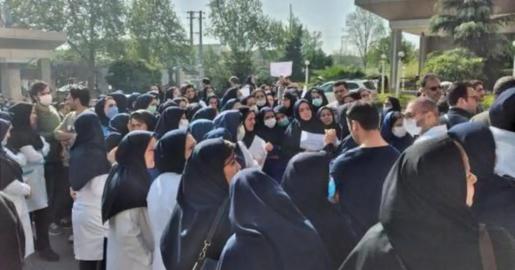
Medical workers across Iran have intensified their demonstrations in recent days, demanding better working conditions.
On Wednesday, nurses and medical staff held rallies in front of the Ministry of Health building in Tehran, as well as in the cities of Marivan, Ahvaz, and Isfahan.
The protesters are voicing concerns over low pay, lack of job security, and poor prospects that have driven many healthcare workers to leave the country.
Teachers' unions expressed solidarity with the nurses, noting that "Iranian nurses have started a strike and protest in recent days."
The statement added, "These protests, which started in Shiraz and have spread across the country, show that this working group is fed up with discrimination and has decided to claim their rights through a collective movement against the government."
The protests come as officials acknowledge the growing crisis.
Iran's head of the Ministry of Health Committee for Cabinet Member Selection, Ali Jafarian, raised an alarm over the mass exodus of healthcare professionals from Iran.
In a statement, Jafarian described the situation of nurses migrating or leaving their jobs as "terrible" and emphasized the wave of nurses emigrating to Germany.
"One by one, nurses are learning German so that they can leave the country," Jafarian said.
He noted that a German language certificate is often all that is needed to facilitate their departure.
The crisis extends beyond nursing. Jafarian revealed that in some smaller hospitals, as many as 30 staff members have emigrated in recent years.
Meanwhile, Iranian authorities on Tuesday closed down the last language institute certified by the German Embassy.
For those seeking to immigrate to Germany on a work visa—particularly nurses—or students aiming to study in German-speaking countries, obtaining a B2 level certificate in German is crucial.
This certification is typically issued by the Goethe German Language Institute.

Interested in writing for IranWire?
Share your stories.


comments